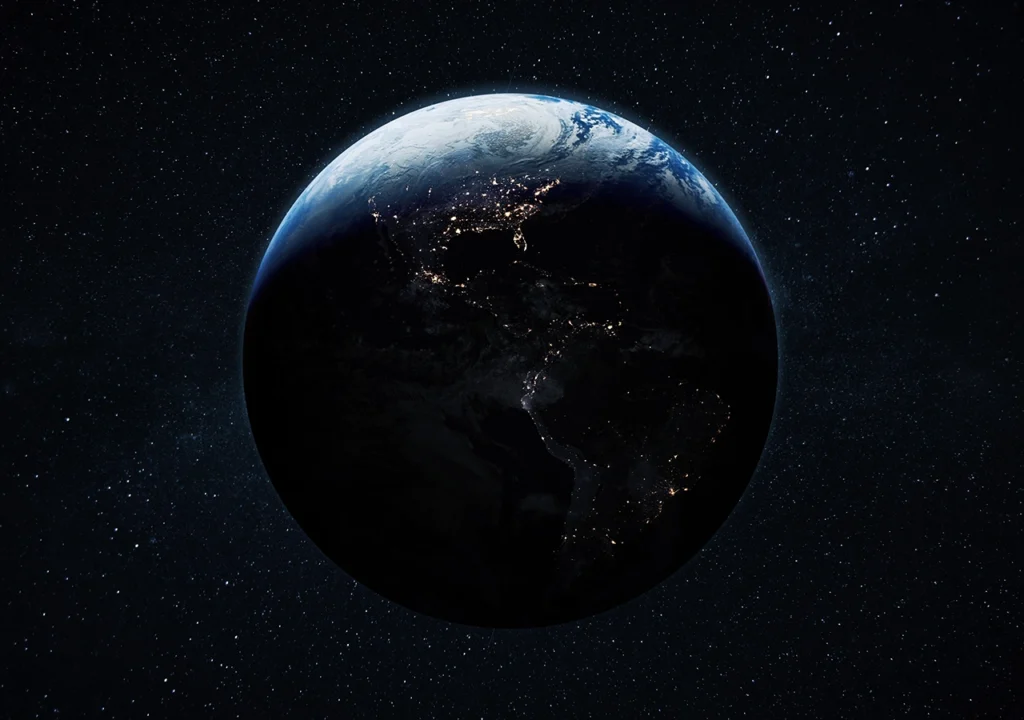
The Sun is the central engine of our solar system. It provides light, heat, and the gravitational force that keeps Earth and all the other planets in stable orbits. Every aspect of life on Earth, from climate and weather to photosynthesis and biological rhythms, ultimately depends on the Sun. Imagining a universe where the Sun suddenly disappears may sound like science fiction, but exploring this scenario helps reveal how deeply Earth and the solar system rely on our star.
If the Sun were to vanish instantly, without warning, the effects would unfold in stages. Some changes would happen immediately, while others would take days, months, or years to fully develop. The outcome would be catastrophic for life as we know it, transforming Earth into a dark and frozen world.
The First Eight Minutes: Light and Gravity
Light from the Sun takes about eight minutes to reach Earth. If the Sun disappeared suddenly, Earth would continue receiving sunlight for those final eight minutes. During this brief window, everything on Earth would appear completely normal. Day and night cycles would continue as usual, and no immediate sign of disaster would be visible.
At the same time, the Sun’s gravitational influence also travels at the speed of light. This means Earth would continue orbiting as if the Sun were still there for those same eight minutes. Once that time passed, both sunlight and the Sun’s gravitational pull would vanish simultaneously.
After those eight minutes, Earth would no longer be bound to the Sun and would begin moving in a straight line through space, following its last orbital direction.
Sudden Darkness Across Earth
Once the Sun’s light stopped reaching Earth, the planet would be plunged into complete darkness. The sky would turn black, even during what was previously daytime. The Moon, which reflects sunlight, would also go dark almost immediately.
Stars would become visible across the entire sky, but their light would provide no warmth. Artificial lighting could temporarily illuminate cities, but this would be a short-lived comfort as energy systems began to fail.
The psychological impact of instant, permanent darkness would be immense, marking the beginning of Earth’s rapid transformation into an uninhabitable world.
The Collapse of Temperature
Without the Sun, Earth would begin losing heat rapidly. The planet’s surface temperature would drop as stored heat radiated into space. Within a few days, average temperatures would fall below freezing across much of the planet.
Within a week, global temperatures could drop to around minus 17 degrees Celsius. Within a year, Earth’s average surface temperature could plunge to minus 73 degrees Celsius or lower. Eventually, temperatures would stabilize near minus 240 degrees Celsius, only slightly above absolute zero.
Oceans would begin to freeze from the surface downward. While deeper layers would remain liquid for some time due to geothermal heat, the surface ice would grow thicker and thicker.
The End of Photosynthesis
Photosynthesis depends entirely on sunlight. Without the Sun, plants, algae, and cyanobacteria would no longer be able to produce energy. Most plants would die within days or weeks, depending on their stored energy reserves.
As plants die, the food chains that depend on them would collapse. Herbivores would starve, followed by carnivores. Ecosystems that took millions of years to develop would disintegrate in a very short time.
Some life forms near deep-sea hydrothermal vents could survive longer, as they rely on chemical energy rather than sunlight. However, these ecosystems are isolated and could not support complex surface life.
Atmospheric Changes
As Earth cooled, the atmosphere would undergo dramatic changes. Water vapor would condense and fall as snow, gradually reducing the amount of greenhouse gases in the air. Carbon dioxide would freeze and fall as dry ice.
Eventually, much of the atmosphere would collapse onto the surface as frozen gases. Oxygen and nitrogen would remain gaseous longer, but even these would eventually freeze at extremely low temperatures.
With no sunlight to drive weather systems, winds would weaken and storms would cease. The dynamic atmosphere we know would become a thin, frozen shell around the planet.
The Fate of the Oceans
The oceans store a vast amount of heat, which would slow Earth’s cooling initially. However, without the Sun’s energy, this heat would gradually escape into space.
Surface layers of the oceans would freeze within weeks to months. Over centuries, ice could extend kilometers deep. Beneath the ice, liquid water might persist for thousands of years, warmed by heat from Earth’s interior.
Despite this, the oceans would no longer support most forms of life. Only small, isolated ecosystems near geothermal sources could survive for extended periods.
Earth’s New Path Through Space
Without the Sun’s gravity, Earth would no longer orbit anything. It would move in a straight line through space, becoming a rogue planet drifting through the galaxy.
Earth’s speed at the moment the Sun disappeared would determine its trajectory. It could pass near other stars or wander alone through interstellar space for billions of years.
The loss of the Sun would also destabilize the orbits of other planets, moons, asteroids, and comets, scattering the remains of the solar system across space.
Could Any Life Survive?
Surface life would be unable to survive long without sunlight and warmth. Humans, animals, and plants would perish relatively quickly as temperatures dropped and food supplies vanished.
Some microorganisms could survive for much longer, especially those living deep underground or near geothermal heat sources. These organisms are adapted to extreme environments and do not rely on sunlight.
If intelligent life attempted to survive, it would need vast underground habitats powered by nuclear or geothermal energy. Even then, long-term survival would be extremely difficult without access to renewable energy sources.
The Long-Term Frozen Earth
Over millions of years, Earth would become a frozen, airless world similar to a giant icy moon. Its surface would be locked in darkness, with glaciers covering continents and frozen oceans stretching from pole to pole.
Geological activity would continue beneath the surface, driven by radioactive decay in Earth’s core. Volcanoes and tectonic movements might still occur, but they would have little effect on the frozen surface.
Earth would remain a silent traveler through space, carrying the frozen remnants of a once-living world.
The Role of the Sun in Life and Stability
This scenario highlights how essential the Sun is to Earth’s habitability. It provides not only light and heat, but also stability. The Sun’s gravity keeps Earth in a stable orbit, while its energy drives weather, climate, and the entire biosphere.
Even small changes in the Sun’s output can have significant effects on Earth. The complete disappearance of the Sun would represent the ultimate loss of stability, leading to the rapid collapse of nearly all Earth systems.
Conclusion
If the Sun disappeared suddenly, Earth would face an immediate and irreversible catastrophe. Darkness would arrive within minutes, temperatures would plummet, ecosystems would collapse, and the planet would drift aimlessly through space.
Life as we know it would not survive, and Earth would become a frozen, lifeless world. This thought experiment underscores the delicate balance that allows life to exist and the central role the Sun plays in maintaining that balance.
Understanding what would happen without the Sun deepens our appreciation for the fragile conditions that make Earth habitable and reminds us how closely our fate is tied to our star.
References
https://science.nasa.gov/sun/overview/
https://www.nasa.gov/solar-system/what-is-the-sun/
https://www.space.com/what-if-the-sun-disappeared
https://astronomy.swin.edu.au/cosmos/S/Sun
https://www.livescience.com/what-if-sun-disappeared