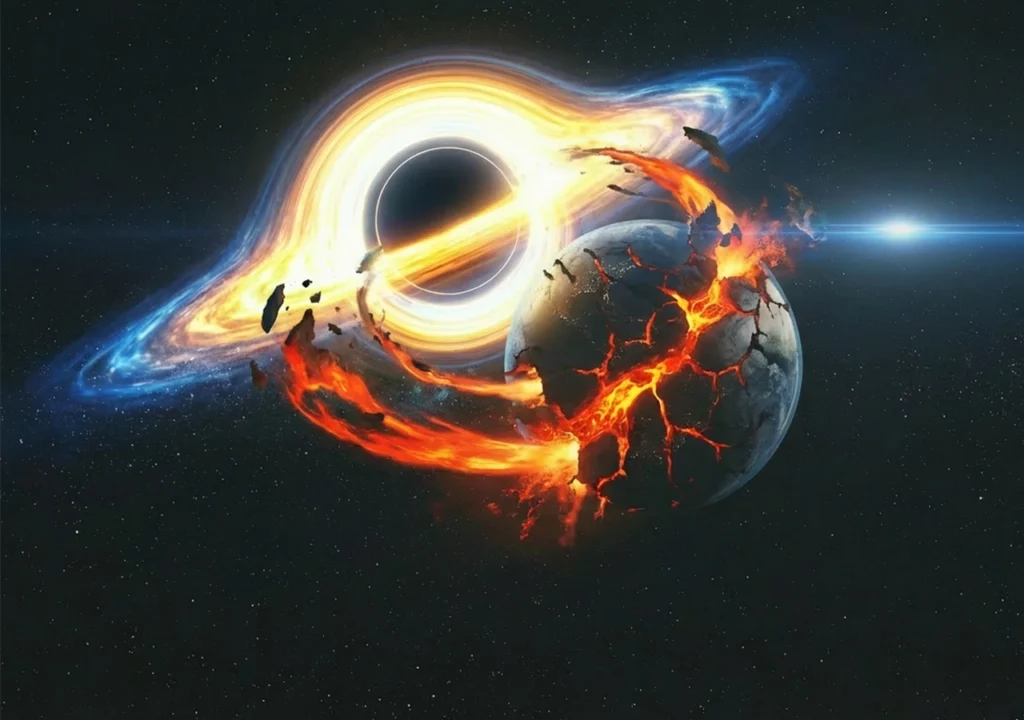
We are all scared of black holes because we know they grasp everything around them. If Earth fell into one, we can imagine that it would smash the planet, break it into parts and lava, and eventually melt it into the black hole. Sounds scary, right? While black holes are often portrayed as abstract cosmic threats, they are real physical objects governed by well-tested laws of physics. Astronomers cannot experiment directly with planets falling into black holes, but they can reconstruct such scenarios using observation, theory, and simulation. By examining gravity, spacetime, radiation, and orbital motion, scientists can describe what would realistically happen if Earth were somehow placed on a collision course with a black hole, step by step, from the first gravitational effects to the final outcome.
The Core Idea in Simple Terms
To understand what would happen if Earth entered a black hole, it is necessary to begin with gravity and spacetime. A black hole forms when a large amount of mass is compressed into an extremely small volume, warping spacetime so strongly that nothing within a certain boundary can escape. That boundary is known as the event horizon. Outside the event horizon, gravity behaves in ways that can be calculated and measured. Inside it, known physics reaches its limits. If Earth approached a black hole, the effects would depend on the black hole’s mass, Earth’s trajectory, and the distance involved.
What We Can Measure Directly
Astronomy begins with photons—light ranging from radio waves to gamma rays—and extends to particles such as cosmic rays and neutrinos. Scientists also measure gravity indirectly through orbital motion, gravitational lensing, and gravitational waves. These tools allow astronomers to study how matter behaves near black holes. By observing stars orbiting black holes and gas heating up as it falls inward, scientists can calculate gravitational strength, tidal forces, and time dilation effects. These measurements provide solid evidence for how gravity behaves outside the event horizon.
What We Must Infer
Many of the most important stages of a planet entering a black hole cannot be observed directly. No signal can return from beyond the event horizon, and conditions there cannot be reproduced in laboratories. Scientists therefore infer what happens using mathematical models derived from general relativity and tested against observable behavior outside the horizon. These models must be consistent with all known observations and physical laws, even when they describe regions that can never be directly seen.
How Scientists Study This Topic
Telescopes and Surveys
Modern telescopes repeatedly observe black holes by studying their effects on nearby stars, gas, and light. Surveys collect large datasets that reveal how matter behaves as it spirals toward black holes. X-ray and radio telescopes are especially important because they detect emissions from extremely hot gas and relativistic jets. These observations help scientists understand how gravity intensifies as objects approach a black hole.
Spectra, Timing, and Motion
Spectroscopy reveals temperature, composition, and motion of matter near black holes. Timing measurements track rapid changes in brightness, indicating compact emitting regions. Motion, measured through Doppler shifts and orbital tracking, reveals mass and gravitational influence. Together, these techniques allow scientists to calculate how tidal forces would act on a planet approaching a black hole.
Simulations and Physical Models
Because real experiments are impossible, simulations play a central role. Supercomputer models simulate planets, stars, and gas falling toward black holes under the equations of general relativity. These simulations allow scientists to test how different black hole masses and approach angles change the outcome. A model is useful only if it reproduces observed behavior outside the event horizon and remains mathematically consistent.
What We Know Today
The Most Reliable Findings
One of the most reliable findings is that black holes do not act like cosmic vacuum cleaners. From far away, a black hole’s gravity behaves just like the gravity of any object with the same mass. Earth would not suddenly be pulled in unless it were placed on a direct trajectory toward the black hole. As Earth approached, gravitational effects would increase gradually, not instantaneously. Another well-established result is that tidal forces become stronger closer to the black hole, stretching objects along the direction of gravity.
The Biggest Uncertainties
The largest uncertainties involve what happens beyond the event horizon. Classical general relativity predicts a singularity where density becomes infinite, but this likely signals a breakdown of the theory rather than a physical reality. Scientists do not yet have a complete theory that unifies gravity with quantum mechanics, so the deepest interior of a black hole remains uncertain.
What Would Earth Experience Before Crossing the Event Horizon
Long before Earth reached the event horizon, significant changes would occur. Tidal forces would begin to distort Earth’s shape, stretching it along the direction of gravity and compressing it sideways. Oceans would experience extreme tides, and the planet’s internal structure would be stressed far beyond its limits. Earth’s orbit would decay, and heating from gravitational energy would increase dramatically. If the black hole were small, these effects would become catastrophic well before reaching the event horizon.
What Happens Near the Event Horizon
As Earth approached the event horizon, relativistic effects would dominate. Time dilation would become extreme, meaning that distant observers would see Earth slow down as it approached the horizon. From Earth’s perspective, however, time would continue normally. Light from the outside universe would appear increasingly distorted, blueshifted in some directions and redshifted in others. Gravity would overwhelm all structural integrity, tearing Earth apart into a stream of matter.
Crossing the Event Horizon
From the perspective of Earth itself, crossing the event horizon would not involve a sudden physical boundary. There would be no visible wall or surface. However, once crossed, escape would be impossible. All possible paths through spacetime would lead further inward. Communication with the outside universe would cease entirely. This marks the point beyond which no observation can ever be made from outside.
Inside the Black Hole
Inside the event horizon, known physics becomes speculative. Classical theory predicts that matter continues to collapse toward a singularity. Tidal forces would become infinite, completely destroying any remaining structure. Whether quantum effects modify this outcome is unknown. What is clear is that Earth, as a planet, would no longer exist as a coherent object.
Common Misconceptions
Viral Explanations vs Scientific Explanations
Popular explanations often suggest that Earth would instantly vanish or be swallowed whole in a dramatic instant. In reality, the process would unfold over time, governed by gravity and relativity. The most destructive effects would occur well before the event horizon, not at the moment of crossing.
‘Unknown’ Does Not Mean ‘Unscientific’
The inability to observe inside a black hole does not make the topic unscientific. Science regularly uses inference to describe inaccessible regions. The physics describing motion up to the event horizon is extremely well tested, even if the final interior state remains uncertain.
What This Could Mean for the Future
New Instruments, Better Answers
Future telescopes and gravitational-wave detectors will improve measurements of black hole environments. Better observations of matter near event horizons will help refine models of tidal forces, spacetime curvature, and extreme gravity.
Limits of Current Knowledge
Even with improved data, some aspects of black holes may remain beyond direct observation. This does not stop progress; instead, it defines the boundary where theory and observation meet.
What Would Happen If Earth Entered a Black Hole? is not merely a hypothetical question but a way to test our understanding of gravity, spacetime, and physical law. By applying known physics to extreme scenarios, scientists clarify what is firmly established and where new discoveries are still needed. The scenario reveals not only the fate of a planet under extreme gravity but also the strengths and limits of modern science itself.
References:
https://science.nasa.gov/
https://www.esa.int/Science_Exploration/Space_Science
https://map.gsfc.nasa.gov/
https://www.space.com/
https://www.cfa.harvard.edu/