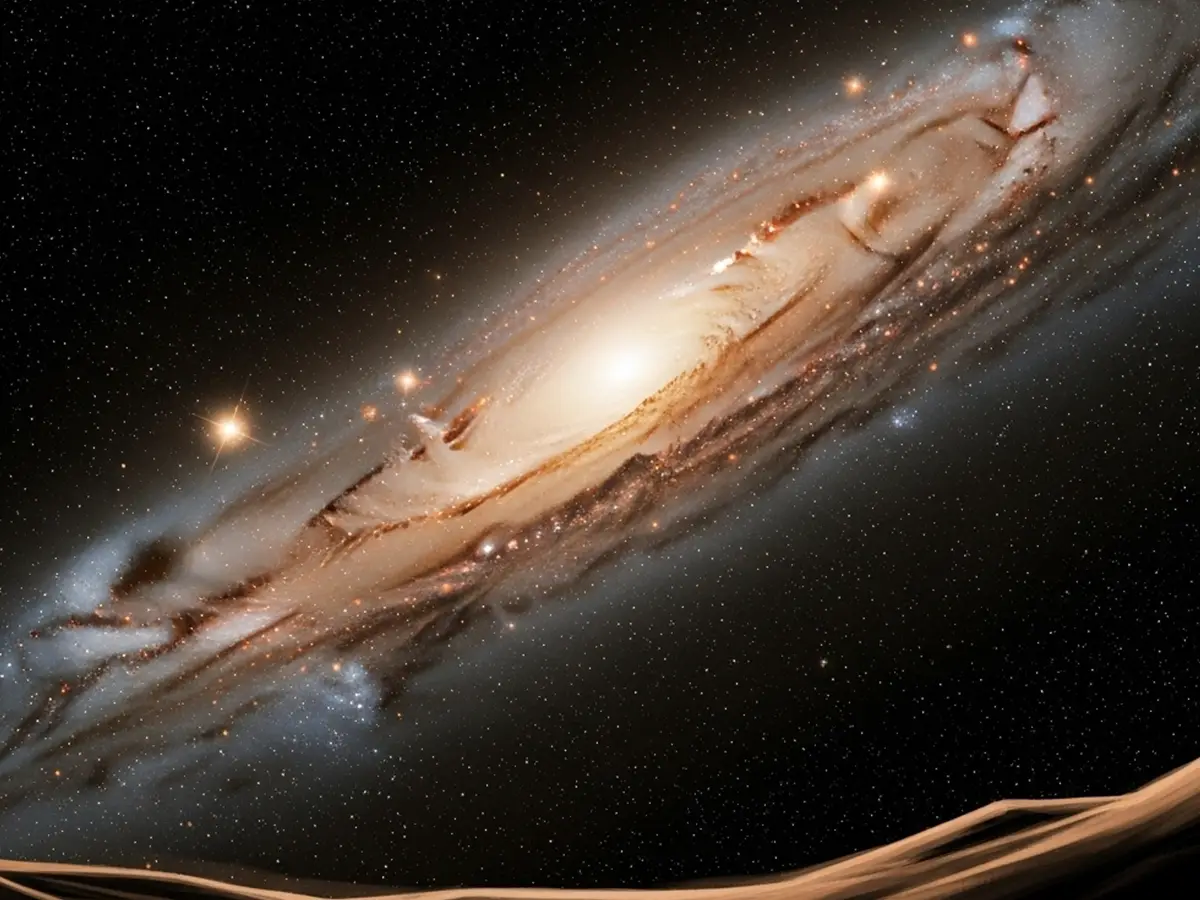
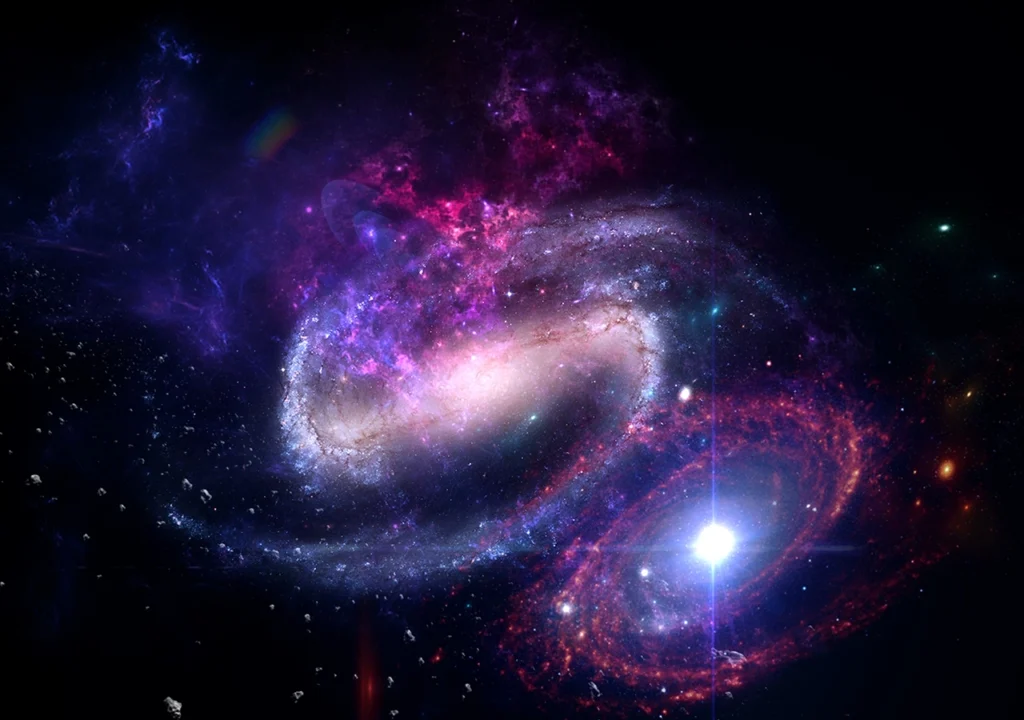
The idea that galaxies across vast regions of the universe might be moving together in a preferred direction has raised serious questions about how large-scale cosmic motion works. The term dark flow is used to describe this observed motion, which appears to extend far beyond what standard cosmological models would normally predict. Astronomers did not arrive at this concept through speculation but through careful measurement of galaxy clusters and the subtle effects those clusters imprint on background radiation. Understanding dark flow requires combining observation, theory, and statistical analysis, all while working at scales far beyond direct experimentation.
Understanding Large-Scale Motion in the Universe
On the largest scales, galaxies are not randomly scattered or stationary. They are embedded in an expanding universe where motion is influenced by gravity, mass distribution, and the overall geometry of space.
Cosmic Expansion and Local Motion
The expansion of the universe causes distant galaxies to move away from one another, a process measured through redshift. On top of this expansion, galaxies also have local motions caused by gravitational attraction toward massive structures such as galaxy clusters and superclusters. These local motions are expected and well explained by standard cosmology.
When Motion Appears Coordinated
Dark flow becomes relevant when motion appears coordinated across extremely large distances. Instead of random local movement, some observations suggest that galaxy clusters separated by hundreds of millions of light-years may share a common directional drift. This challenges the assumption that, on the largest scales, the universe should appear statistically uniform in all directions.
How Dark Flow Was Detected
Dark flow was not discovered by tracking visible motion directly but through indirect measurement techniques that rely on background radiation and subtle temperature shifts.
The Kinematic Sunyaev–Zel’dovich Effect
One of the primary tools used to study dark flow is the kinematic Sunyaev–Zel’dovich effect. When cosmic microwave background radiation passes through hot gas in galaxy clusters, it can gain or lose energy depending on the motion of that gas. By measuring these tiny temperature changes, astronomers can infer the direction and speed of cluster motion.
Use of Cosmic Microwave Background Data
Observations from satellites studying the cosmic microwave background provide a uniform reference frame against which motion can be measured. By analyzing data from many galaxy clusters and comparing them to this background radiation, researchers attempt to detect coherent motion patterns that may indicate dark flow.
What Current Observations Show
Measurements related to dark flow are subtle and require averaging signals across many clusters to reduce noise.
Reported Velocity Scales
Some studies have reported bulk motions of galaxy clusters on the order of hundreds of kilometers per second extending across very large distances. If confirmed, such motion would exceed what is expected from known gravitational structures within the observable universe.
Limits and Measurement Challenges
The signals involved are extremely small, and separating them from background noise is difficult. Instrument sensitivity, data processing methods, and assumptions about cluster properties all affect the final results. Because of this, different studies sometimes reach different conclusions.
Possible Explanations Within Known Physics
Several explanations have been proposed that attempt to explain dark flow without invoking entirely new physics.
Large-Scale Mass Concentrations
One possibility is that very large, distant mass concentrations outside the observable universe exert gravitational influence. While these regions cannot be directly observed, their gravitational effects could, in principle, extend into observable space.
Statistical Effects and Data Interpretation
Another explanation is that apparent dark flow may result from statistical fluctuations or biases in data analysis. When signals are near the limits of detection, small systematic errors can create the illusion of coherent motion.
Explanations That Push Beyond Standard Models
If dark flow cannot be fully explained by known structures or statistical effects, more radical explanations are considered.
Pre-Inflationary Structure
Some theories suggest that dark flow could be a remnant of structures that existed before cosmic inflation. In this view, the universe may carry imprints of conditions that existed prior to the rapid expansion phase that shaped observable space.
Modifications to Cosmological Assumptions
Other ideas involve questioning assumptions about isotropy and homogeneity at the largest scales. If the universe is not perfectly uniform beyond certain distances, large-scale motion patterns could emerge naturally.
Relationship to Dark Matter and Dark Energy
Despite the name, dark flow is not directly caused by dark matter or dark energy, though it is related to how mass and energy shape cosmic motion.
Distinction From Dark Matter
Dark matter affects galaxy motion within clusters and contributes to structure formation, but dark flow refers to coordinated motion across much larger scales. The two concepts involve different physical questions.
Distinction From Dark Energy
Dark energy drives the accelerated expansion of the universe but does not explain directional motion. Dark flow, if real, represents a separate phenomenon layered on top of expansion.
What Scientists Agree On
There is broad agreement on some aspects of the dark flow discussion.
Confirmed Observational Frameworks
The methods used to measure cluster motion, such as the Sunyaev–Zel’dovich effect, are well established and independently verified in other contexts.
Ongoing Debate on Interpretation
What remains debated is whether the observed signals truly indicate large-scale coherent motion or whether they arise from limitations in data and analysis. This debate is active and ongoing.
Why the Question Remains Open
Dark flow remains unresolved because it sits at the boundary of observational capability.
Data Sensitivity Limits
Detecting motion at such scales requires extreme precision. Small improvements in instrumentation can significantly change conclusions.
Need for Independent Verification
Multiple independent datasets and methods are required to confirm or refute dark flow conclusively. Until then, no single study can settle the question.
Looking Ahead With Future Observations
Future missions and surveys will provide better data to address the dark flow question.
Improved Cosmic Background Mapping
Higher-resolution measurements of the cosmic microwave background will reduce uncertainty in motion estimates.
Larger Cluster Samples
Observing more galaxy clusters across wider distances will improve statistical confidence and reduce bias.
The question of what is pulling galaxies across space under the label of dark flow reflects how science progresses at the limits of observation. By refining measurements and testing explanations against increasingly precise data, astronomers continue to evaluate whether dark flow represents a real large-scale phenomenon or a challenge that will ultimately reinforce existing models.
References:
https://science.nasa.gov/
https://www.esa.int/Science_Exploration/Space_Science
https://map.gsfc.nasa.gov/
https://www.space.com/
https://www.cfa.harvard.edu/