The Cosmic Microwave Background, often called the CMB, is one of the most important discoveries in modern astronomy. It is a faint glow of radiation that fills the entire universe and can be detected in every direction of the sky. Although it is invisible to the human eye, sensitive instruments reveal it as a uniform background of microwave radiation. This ancient light is a direct remnant from the early universe and provides a snapshot of the cosmos when it was still extremely young.
The CMB is not just background noise or leftover heat. It is a powerful source of information that helps scientists understand how the universe began, how it evolved, and why it looks the way it does today. By studying this radiation, astronomers can trace cosmic history back to a time long before stars, galaxies, or planets existed.
The Early Universe Before the CMB
In the earliest moments after the universe began, everything was incredibly hot, dense, and tightly packed together. Matter and energy existed in a state where particles constantly collided, and light could not travel freely. The universe was filled with a glowing plasma made of electrons, protons, and photons all interacting continuously.
During this early phase, the universe was opaque, meaning light could not move very far before being scattered. Photons were trapped in this dense environment, bouncing endlessly between charged particles. At this stage, the universe did not resemble anything like the structured cosmos we see today.
As the universe expanded, it gradually cooled. This cooling process played a crucial role in shaping the conditions that eventually allowed light to travel freely and leave behind the radiation we now observe as the Cosmic Microwave Background.
The Moment Light Was Released
Roughly 380,000 years after the universe began, temperatures dropped enough for electrons and protons to combine and form neutral hydrogen atoms. This event is known as recombination. Once atoms formed, there were far fewer free charged particles to scatter photons.
At this moment, light was finally able to travel freely through space. The photons released during this time spread outward in all directions and have been traveling ever since. These photons make up the Cosmic Microwave Background we detect today.
Although this radiation originally had much higher energy, the continuous expansion of the universe stretched its wavelength over billions of years. What was once hot visible and infrared light has now cooled into microwave radiation, just a few degrees above absolute zero.
Why the CMB Is Everywhere
The Cosmic Microwave Background surrounds us completely because it comes from all directions in space. No matter where you look, you are seeing radiation that originated from the same early moment in cosmic history. This does not mean there is a single center point emitting the CMB. Instead, it reflects the fact that the universe expanded uniformly in all directions.
As space itself expanded, the light traveling through it was stretched along with it. This is why the CMB appears nearly uniform across the sky. Small variations do exist, but the overall consistency tells scientists that the universe was remarkably smooth and evenly distributed at an early stage.
This uniformity supports the idea that the universe began in a hot, dense state and expanded rapidly, laying the foundation for everything that followed.
Temperature and Tiny Fluctuations
The average temperature of the Cosmic Microwave Background today is about 2.7 degrees above absolute zero. This extreme cold reflects how much the universe has expanded and cooled over time. However, the CMB is not perfectly uniform. Tiny temperature differences exist at a level of just a few millionths of a degree.
These small variations are incredibly important. They represent tiny differences in density in the early universe. Regions that were slightly denser had stronger gravitational pull and eventually grew into galaxies, clusters of galaxies, and large-scale cosmic structures.
Without these fluctuations, matter would not have clumped together, and the universe might have remained a smooth, featureless expanse of gas. The CMB therefore contains the seeds of all cosmic structure.
How Scientists Detect the CMB
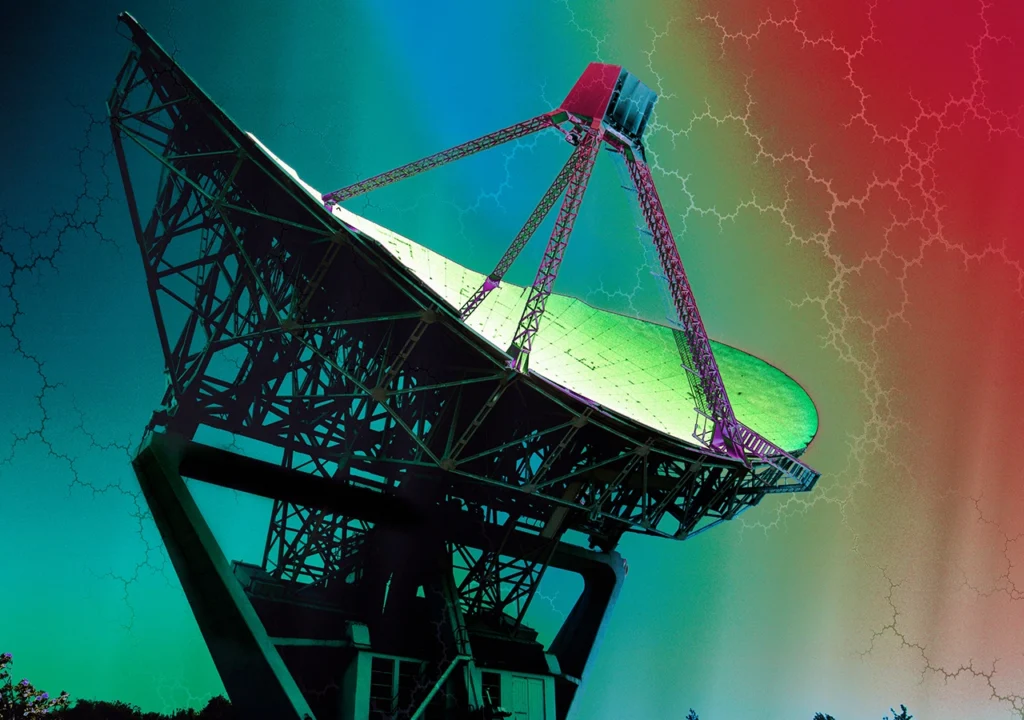
Because the Cosmic Microwave Background exists at microwave wavelengths, it cannot be seen with optical telescopes. Instead, scientists use specialized instruments that can detect faint microwave radiation from space.
Early experiments detected the CMB accidentally, but later missions were designed specifically to map it with increasing precision. Satellites placed far from Earth’s atmosphere measure temperature differences across the sky and produce detailed maps of the CMB’s structure.
These measurements are so precise that they allow scientists to test theories about the universe’s shape, age, and composition with remarkable accuracy.
What the CMB Reveals About the Universe’s Age
One of the most important contributions of the Cosmic Microwave Background is its role in determining the age of the universe. By analyzing the patterns and fluctuations in the CMB, scientists can estimate how fast the universe has been expanding and how its expansion rate has changed over time.
These measurements indicate that the universe is about 13.8 billion years old. This age estimate is consistent with other observations, such as the motion of galaxies and the evolution of stars, but the CMB provides one of the most precise methods available.
The CMB acts like a cosmic timestamp, marking a well-defined moment early in the universe’s history and allowing scientists to calculate everything that followed.
Evidence for the Big Bang
The discovery of the Cosmic Microwave Background provided strong evidence that the universe began in a hot, dense state. Before its detection, there were competing ideas about the origin of the universe. Some models suggested the universe had always existed in roughly the same form.
The CMB strongly supports the Big Bang model because it matches predictions made decades earlier. A universe that began hot and dense should leave behind a cooled, uniform background of radiation, exactly what astronomers observe.
This discovery transformed cosmology into a precise scientific field, grounded in observable evidence rather than speculation.
The CMB and the Shape of the Universe
The patterns found in the Cosmic Microwave Background also reveal information about the geometry of the universe. By studying the size and distribution of temperature fluctuations, scientists can determine whether space is flat, curved inward, or curved outward.
Measurements of the CMB indicate that the universe is very close to geometrically flat. This means that, on large scales, the rules of geometry we learn in school apply across the cosmos.
This finding has major implications for theories about how the universe began and how it will evolve in the future.
Dark Matter and the CMB
The Cosmic Microwave Background provides strong evidence for the existence of dark matter. Although dark matter does not emit or absorb light, it influences the motion of matter through gravity.
The way temperature fluctuations appear in the CMB depends on how much dark matter existed in the early universe. Observations show patterns that can only be explained if dark matter makes up a significant portion of the universe’s total mass.
By studying the CMB, scientists can estimate how much dark matter exists and how it influenced the growth of cosmic structures.
Dark Energy and Cosmic Expansion
In addition to dark matter, the CMB also offers clues about dark energy, the mysterious force driving the accelerated expansion of the universe. While the CMB itself comes from an early time, its detailed structure reflects how expansion has changed over billions of years.
When combined with other observations, CMB data helps scientists understand how dark energy affects the universe’s overall evolution. This makes the CMB a key piece of evidence in studying the most mysterious components of the cosmos.
The CMB as a Cosmic Blueprint
The Cosmic Microwave Background acts like a blueprint for the universe. It shows the initial conditions from which all cosmic structures formed. Galaxies, clusters, and vast cosmic filaments all grew from the tiny density variations recorded in the CMB.
By comparing modern observations of the universe with this early snapshot, scientists can test their models of cosmic evolution. When predictions match observations, confidence in our understanding of the universe grows.
The CMB therefore links the earliest moments of cosmic history with the large-scale universe we see today.
Why the CMB Still Matters Today
Even decades after its discovery, the Cosmic Microwave Background remains a central focus of cosmological research. New experiments continue to measure it with increasing sensitivity, searching for subtle signals that could reveal new physics.
Scientists study the polarization of the CMB to learn more about conditions in the very early universe, including possible evidence of rapid expansion shortly after the universe began. These studies may help answer fundamental questions about gravity, space, and time.
The CMB continues to serve as a foundation for modern cosmology, guiding research into the universe’s deepest mysteries.
To summarise, we can say that the Cosmic Microwave Background is far more than faint background radiation. It is the oldest light in the universe and a direct window into the cosmos’s earliest era. By studying it, scientists have learned how the universe began, how old it is, what it is made of, and how it has evolved over time.
From confirming the Big Bang to revealing the roles of dark matter and dark energy, the CMB has transformed our understanding of the universe. It connects the birth of the cosmos to the vast structures we see today and remains one of the most powerful tools in astronomy.
As technology advances, the Cosmic Microwave Background will continue to provide insights into questions that reach far beyond our galaxy, helping humanity better understand its place in the universe.
References
https://science.nasa.gov/universe/cosmic-microwave-background/
https://map.gsfc.nasa.gov/universe/bb_cosmo.html
https://www.esa.int/Science_Exploration/Space_Science/Planck/Cosmic_microwave_background
https://www.space.com/cosmic-microwave-background-explained
https://astronomy.swin.edu.au/cosmos/C/Cosmic+Microwave+Background