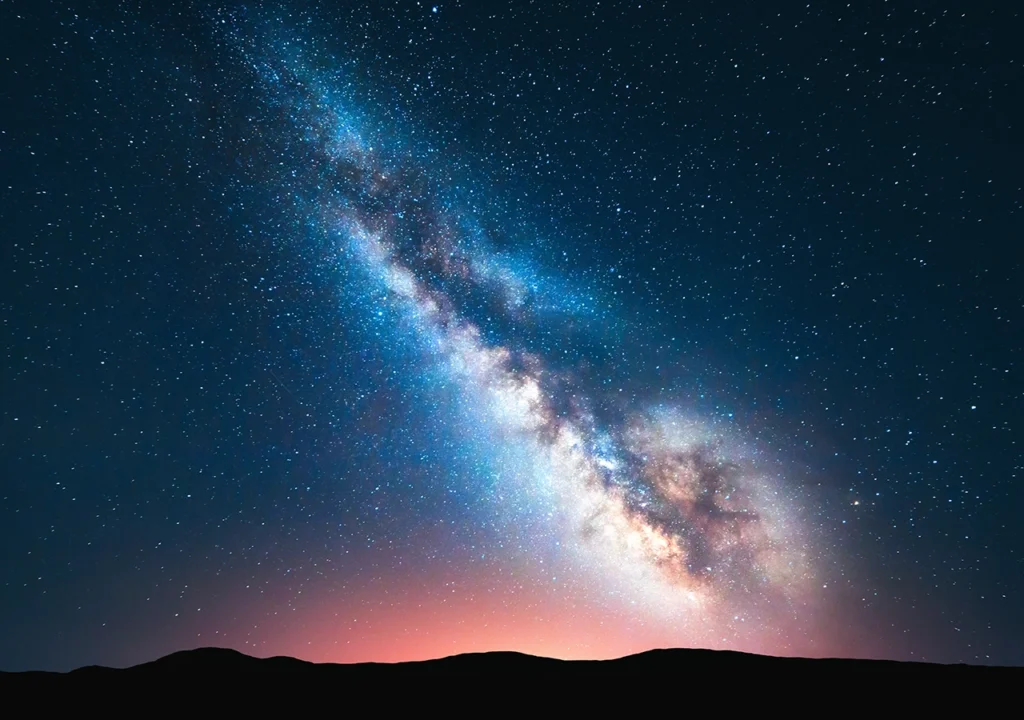
The center of the Milky Way is one of the most mysterious and extreme regions in our galaxy. Located about 26,000 light-years away from Earth in the direction of the constellation Sagittarius, it is hidden from direct view by dense clouds of gas and dust that block visible light. For a long time, this made the heart of our galaxy impossible to study using traditional telescopes. Only with the development of infrared, radio, and high-energy astronomy have scientists been able to uncover what truly lies at the Milky Way’s core.
Rather than being a calm or empty region, the galactic center is a crowded and energetic environment filled with stars packed tightly together, massive clouds of gas, powerful magnetic fields, and intense radiation. At its very heart lies a supermassive black hole that plays a central role in shaping everything around it. Together, these components form a dynamic system that influences the structure, evolution, and behavior of the entire Milky Way galaxy.
Locating the Galactic Center
The Milky Way is a barred spiral galaxy, meaning it has a bright central bar-shaped structure made of stars, with spiral arms extending outward. The galactic center lies at the middle of this bar. From Earth’s position inside one of the spiral arms, our line of sight toward the center passes through vast amounts of interstellar dust, which absorbs and scatters visible light.
To overcome this limitation, astronomers observe the galactic center using wavelengths that can pass through dust more easily. Infrared light reveals stars hidden behind dust clouds, while radio waves map gas and magnetic structures. X-ray and gamma-ray observations expose high-energy processes that occur close to the most extreme objects. By combining data from these different wavelengths, scientists have built a detailed picture of the Milky Way’s inner region.
Sagittarius A*: The Heart of the Milky Way
At the very center of the Milky Way lies Sagittarius A, a compact and powerful radio source. This object is now known to be a supermassive black hole with a mass of about four million times that of the Sun. Despite its enormous mass, Sagittarius A occupies a region roughly the size of our solar system.
The existence of this black hole was confirmed by observing the motion of nearby stars. These stars orbit an invisible point at extremely high speeds, some completing an orbit in just a few years. Such rapid motion can only be explained by the gravitational pull of a very massive and compact object. Sagittarius A* acts as the gravitational anchor of the galaxy, influencing the motion of stars and gas throughout the central region.
Although it is relatively quiet compared to black holes in some other galaxies, Sagittarius A* still occasionally consumes nearby gas and dust. These events produce bursts of radiation that provide valuable clues about how matter behaves under extreme gravity.
Dense Star Clusters Near the Core
Surrounding Sagittarius A* is one of the densest star populations in the Milky Way. In this region, stars are packed millions of times closer together than in the neighborhood of our Sun. The intense gravitational environment leads to complex and fast-moving stellar orbits.
The galactic center contains both very old stars and surprisingly young, massive stars. The presence of young stars close to a supermassive black hole is unexpected, because the strong gravitational forces and radiation should disrupt the star formation process. Yet observations show that star formation has occurred there relatively recently, suggesting that stars can form even in extremely hostile conditions.
These stars release enormous amounts of energy through radiation and stellar winds, contributing to the already energetic environment of the galactic center.
Giant Clouds of Gas and Dust
The inner region of the Milky Way is filled with massive clouds of gas and dust, some containing millions of times the mass of the Sun. These clouds are far denser and more turbulent than those found in the outer parts of the galaxy. Strong gravitational forces, shock waves, and radiation constantly stir them.
These gas clouds are both a source of new stars and fuel for the central black hole. As gas flows inward, it can form stars or spiral toward Sagittarius A*, occasionally triggering bursts of activity. At the same time, tidal forces from the black hole and nearby stars can tear clouds apart, making star formation inefficient and chaotic.
This balance between creation and destruction makes the galactic center a region of constant change.
Extreme Energy and Radiation Environment
The center of the Milky Way is one of the most energetic places in the galaxy. X-ray and gamma-ray observations reveal high-energy particles moving at nearly the speed of light. These particles are accelerated by shock waves from stellar winds, supernova explosions, and interactions with strong magnetic fields.
The intense radiation heats surrounding gas and dust, causing them to glow brightly in infrared wavelengths. This continuous energy input prevents the region from cooling and settling into a stable state. Instead, the galactic center remains hot, active, and highly dynamic.
These energetic conditions also affect the chemistry of the region, breaking apart molecules and forming complex compounds that are rarely seen elsewhere.
Powerful Magnetic Fields
Magnetic fields near the galactic center are much stronger and more organized than those in most other parts of the Milky Way. Long, narrow filaments stretching for tens of light-years glow in radio wavelengths, tracing the paths of charged particles moving along magnetic field lines.
These magnetic fields help guide the flow of gas and energy through the central region. They influence star formation, control the movement of charged particles, and may even play a role in launching material away from the galactic center.
Although their exact origin is still being studied, these magnetic structures are a key part of what makes the Milky Way’s core so unusual.
Evidence of Past Outbursts
While Sagittarius A* is relatively calm today, evidence suggests it was far more active in the past. Large bubble-like structures extending above and below the plane of the galaxy indicate that powerful outflows once erupted from the center. These features suggest that the black hole consumed large amounts of matter millions of years ago, releasing vast quantities of energy.
Other signs of past activity include expanding shells of gas and unusual radiation patterns. These ancient outbursts may have influenced star formation far from the center, showing that events near the core can affect the entire galaxy.
The galactic center’s history appears to be one of cycles, alternating between quiet periods and dramatic activity.
Supernova Remnants in the Central Region
The high concentration of massive stars near the galactic center means that supernova explosions occur more frequently there than in quieter regions of the Milky Way. When these massive stars reach the end of their lives, they explode and send powerful shock waves through surrounding space.
These shock waves compress and heat nearby gas, sometimes triggering new star formation while also disrupting existing clouds. Supernovae also enrich the region with heavy elements, adding to the chemical complexity of the galactic center.
The combined effects of frequent supernova explosions contribute to the turbulent and energetic nature of the Milky Way’s core.
The Role of the Galactic Bar
The Milky Way’s central bar plays an important role in shaping the environment near the core. As stars and gas orbit within the bar, gravitational forces funnel gas inward toward the galactic center. This steady flow of material helps maintain the dense gas clouds found there.
The motion of stars in this region is complex, influenced by the bar, the central black hole, and the overall mass distribution of the galaxy. By studying these motions, astronomers learn more about how the Milky Way formed and how it continues to evolve over time.
Dark Matter Near the Galactic Center
Dark matter, although invisible, is believed to be present throughout the Milky Way, including near the center. Its gravitational influence affects the motion of stars and gas, helping shape the galaxy’s structure.
Determining the exact distribution of dark matter near the galactic center is challenging because of the region’s complexity. However, understanding its role is essential for building accurate models of the Milky Way and explaining how galaxies behave on large scales.
The interaction between dark matter, visible matter, and the supermassive black hole creates a delicate balance that governs the dynamics of the central region.
How the Galactic Center Shapes the Milky Way
The processes occurring at the center of the Milky Way influence the entire galaxy. Energy released near the core can heat gas far from the center, affecting how and where new stars form. Material expelled from the central region spreads heavy elements throughout the galaxy, enriching future generations of stars and planets.
The gravitational pull of the central mass also helps stabilize the galaxy’s structure, supporting the spiral arms and overall rotation pattern. Without a dense and active core, the Milky Way would look very different from what we observe today.
Ongoing Exploration of the Galactic Center
Modern astronomy continues to reveal new details about the Milky Way’s center. Infrared telescopes peer through dust to track stars near Sagittarius A*, while radio and X-ray observatories study energetic events and magnetic structures.
Long-term observations of stellar orbits provide precise measurements of the black hole’s mass and test theories of gravity under extreme conditions. Each new discovery adds to our understanding of how the galactic center works and how similar regions behave in other galaxies.
Future observatories are expected to uncover even more about the behavior of matter and energy in this remarkable region.
The center of the Milky Way is a crowded, energetic, and constantly changing environment that holds the key to understanding our galaxy. At its heart lies a supermassive black hole surrounded by dense star clusters, massive gas clouds, strong magnetic fields, and intense radiation.
Rather than being a quiet core, the galactic center is a powerful engine that shapes the structure and evolution of the Milky Way. Its influence extends far beyond its immediate surroundings, affecting star formation, chemical enrichment, and the overall balance of the galaxy.
By studying what lies inside the center of the Milky Way, scientists gain insight not only into our own galaxy, but into the nature of galaxies throughout the universe.
References
https://www.nasa.gov/mission_pages/chandra/multimedia/galactic-center.html
https://science.nasa.gov/milky-way/galactic-center/
https://www.eso.org/public/science/galactic-centre/
https://eventhorizontelescope.org/press-release-april-2022-eht-reveals-first-image-black-hole-heart-our-galaxy
https://www.space.com/galactic-center-milky-way
https://astronomy.swin.edu.au/cosmos/G/Galactic+Centre