What Is Beyond a Black Hole’s Event Horizon? is the kind of question that makes space feel both measurable and mysterious at the same time. Black holes are among the most extreme objects in the universe, and the event horizon represents a boundary beyond which nothing can return. Astronomers cannot see past this boundary directly, yet they are confident that physics does not simply stop there. Instead, scientists rely on indirect clues—light curves, spectra, motion, timing, and gravitational effects—to reconstruct what must be happening in regions that can never be observed directly. This topic sits at the edge of human knowledge, where tested theories meet unanswered questions.
The Core Idea in Simple Terms
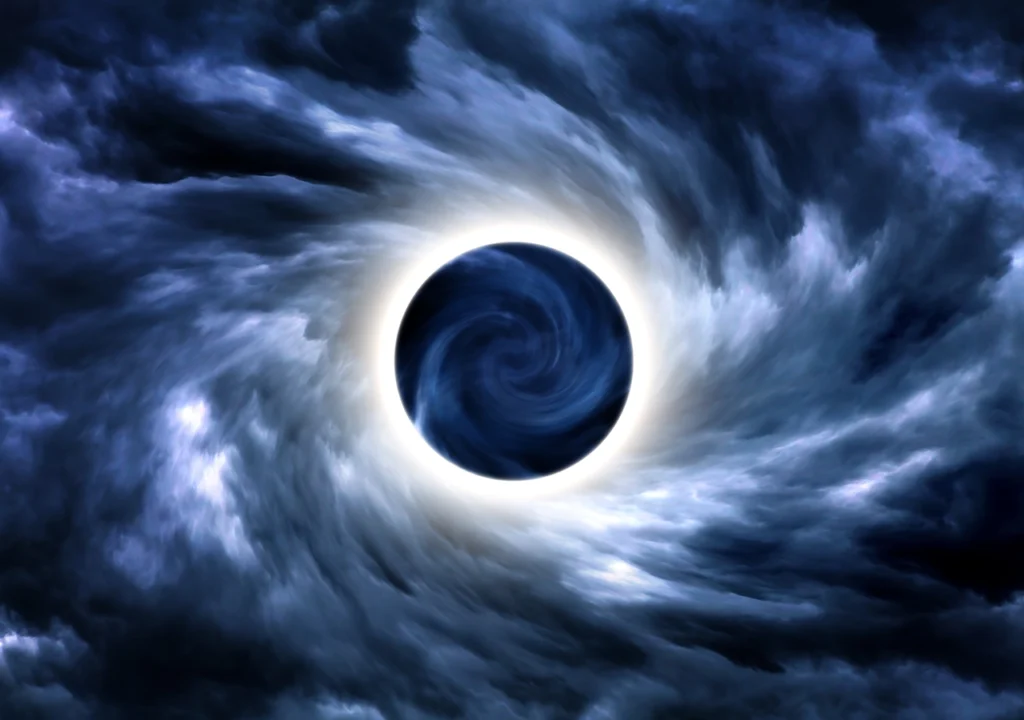
To understand what is beyond a black hole’s event horizon, it helps to begin with gravity and spacetime. A black hole forms when a massive object collapses under its own gravity, compressing matter into an extremely small region. The event horizon is the point where gravity becomes so strong that not even light can escape. From the outside, this boundary looks like a surface, but it is not a physical wall. Instead, it is a mathematical boundary in spacetime. Beyond it, all paths through space and time lead inward. What happens after crossing that boundary is governed by the same physical laws we know, but under conditions far beyond everyday experience.
What We Can Measure Directly
Astronomy begins with photons—light ranging from radio waves to gamma rays. Even though light cannot escape from inside the event horizon, scientists can observe what happens just outside it. Matter falling toward a black hole heats up and emits intense radiation before crossing the horizon. Telescopes can detect this radiation and measure how it changes over time. Scientists also observe how nearby stars orbit an invisible central mass, revealing the black hole’s gravity. Gravitational waves produced by black hole mergers provide another direct measurement, allowing researchers to study how spacetime itself ripples when black holes collide.
What We Must Infer
Everything beyond the event horizon must be inferred rather than observed. Once matter crosses the horizon, no signal can return. Scientists therefore rely on mathematical models that must be consistent with observations outside the horizon and with well-tested physical laws. These models describe what happens to matter, energy, and spacetime as they move inward. Some models predict that matter is crushed into an infinitely dense point called a singularity, while others suggest that new physics may emerge at extreme densities. Because these regions cannot be observed directly, multiple interpretations remain possible.
How Scientists Study This Topic
Telescopes and Surveys
Modern telescopes continuously scan the sky, collecting massive datasets that reveal black holes through their effects on surrounding matter. X-ray observatories detect hot gas spiraling toward black holes, while radio telescopes map jets of particles launched from their vicinity. Large surveys allow scientists to find patterns across thousands of black holes, helping distinguish universal behavior from rare exceptions. Long-term observation is essential because black hole activity can change over years or decades.
Spectra, Timing, and Motion
Spectroscopy shows how matter behaves near the event horizon. Broad spectral lines indicate gas moving at extreme speeds, distorted by gravity and relativity. Timing studies reveal rapid flickering in brightness, showing that the emitting region must be compact. Motion measurements track stars or gas clouds orbiting unseen masses, allowing scientists to calculate black hole mass and confirm the presence of an event horizon rather than a solid surface.
Simulations and Physical Models
Because experiments are impossible, simulations act as laboratories. Supercomputer models incorporate general relativity, magnetism, and plasma physics to simulate matter falling into black holes. Scientists test “what if” scenarios and compare simulated predictions to real observations. A model is only useful if it explains known behavior and predicts new observations that can later be tested. Over time, models are refined as data improves.
What We Know Today
The Most Reliable Findings
Certain facts are well established. Black holes exist and behave according to general relativity in many tested situations. Event horizons act as one-way boundaries for information. Matter outside the horizon emits predictable radiation as it accelerates and heats up. Observations of black hole mergers and gravitational waves strongly support these conclusions. Across many systems, black holes appear consistent with theoretical predictions.
The Biggest Uncertainties
The largest uncertainties involve what happens at the deepest interior. Classical relativity predicts a singularity, but this may signal the breakdown of the theory rather than a real physical object. Scientists do not yet have a complete theory that combines gravity with quantum mechanics, which is likely required to fully describe conditions beyond the event horizon. Another uncertainty concerns information: whether information about infalling matter is truly lost or preserved in some subtle way remains an active area of research.
Common Misconceptions
Viral Explanations vs Scientific Explanations
Popular explanations often describe black holes as cosmic vacuum cleaners or portals to other universes. In reality, black holes only pull in matter that comes very close, and most behave like any other massive object at a distance. Claims that scientists “know” exactly what lies beyond the event horizon are misleading. Real science emphasizes uncertainty, evidence, and testable predictions rather than absolute answers.
‘Unknown’ Does Not Mean ‘Unscientific’
The fact that something cannot be observed directly does not make it unscientific. Many scientific discoveries rely on inference, from atoms to exoplanets. The interior of a black hole is unknown because it is fundamentally hidden, not because scientists lack rigor. This boundary marks the current limit of observation, not the limit of scientific reasoning.
What This Could Mean for the Future
New Instruments, Better Answers
Future observatories will measure black holes with greater precision. Improved gravitational-wave detectors will capture more mergers, revealing details about spacetime near event horizons. High-resolution imaging may further test whether event horizons behave exactly as predicted. Better data will help rule out incorrect models and refine those that remain.
Why This Topic Will Stay Popular
What Is Beyond a Black Hole’s Event Horizon? stays popular because it sits at the boundary between what humans can measure and what the universe hides. It combines extreme physics, deep mathematics, and real observations. Each discovery sharpens our understanding while reminding us that some questions remain open.
What Is Beyond a Black Hole’s Event Horizon? is not just an internet mystery but a central scientific question about how reality works at its limits. As observations improve and theories evolve, the picture will become clearer, yet new questions will emerge. That balance between knowledge and mystery ensures that black holes—and what lies beyond their event horizons—will continue to captivate curiosity for generations.
References:
https://science.nasa.gov/
https://www.esa.int/Science_Exploration/Space_Science
https://map.gsfc.nasa.gov/
https://www.space.com/
https://www.cfa.harvard.edu/