Introduction: A Planet Hidden in Cosmic Rings
In 2025, astronomers announced a discovery that planet-formation theorists have been waiting on for years: the first confirmed exoplanet found inside a multi-ring disk around a star. The young world, named WISPIT 2b, isn’t just another dot on an exoplanet list. It sits right in a gap between bright rings of dust and gas around its star, exactly where models predicted newborn planets should be hiding.
For the first time, we can point to a multi-ring disk, show the carved-out gap, and say with confidence: there is the planet doing the carving. That makes the WISPIT 2 system a kind of Rosetta Stone for understanding how giant planets grow and reshape their birth environments.
Meet WISPIT 2 and Its Baby Planet
The newly famous system is built around WISPIT 2, a young Sun-like star located about 430–440 light-years away in the southern sky. It’s only around 5 million years old, essentially a toddler compared to our 4.6-billion-year-old Sun.
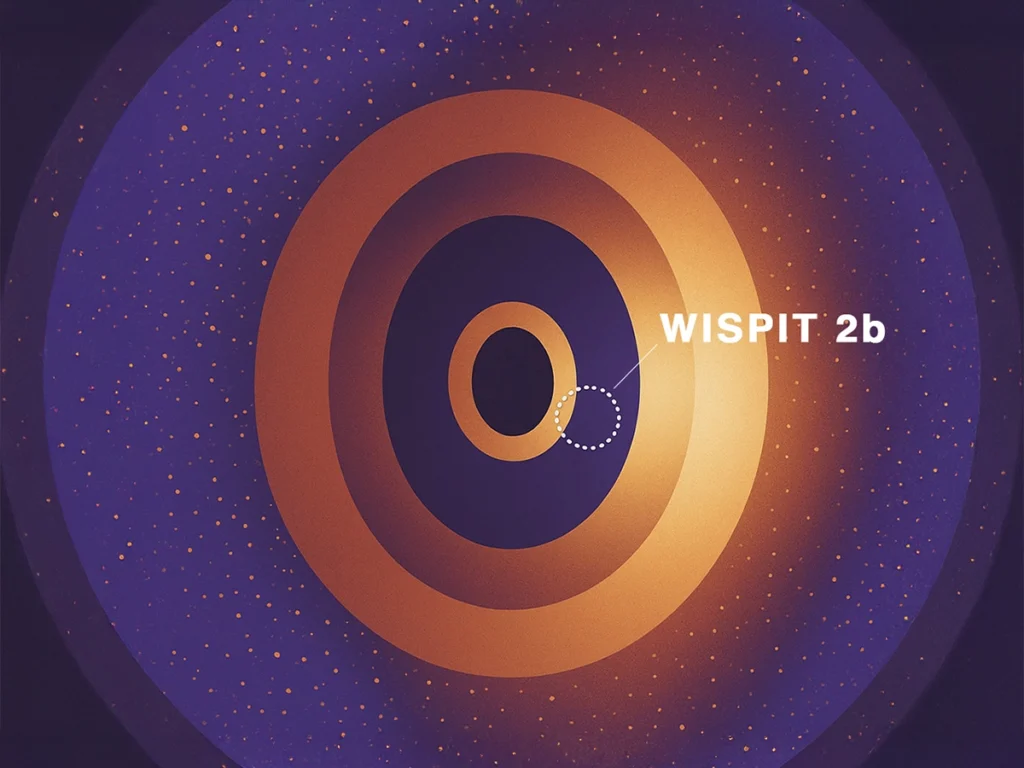
Surrounding WISPIT 2 is a wide protoplanetary disk of dust and gas with a radius of roughly 380 astronomical units (AU)—380 times the Earth–Sun distance and several times larger than our entire solar system. This disk isn’t smooth. High-resolution images show multiple bright rings separated by darker gaps, giving it the appearance of a cosmic vinyl record.
In one of those gaps sits WISPIT 2b:
- A gas-giant protoplanet, still forming
- Likely 4–10 times the mass of Jupiter
- Orbiting at about 57 AU from its star – farther out than Neptune is from the Sun
- Only about 5 million years old, still glowing from birth
This is not a mature planet on a settled orbit; it’s a planet in progress, embedded right inside the material that is feeding and shaping it.
What Is a Multi-Ring Disk – and Why Is It Important?
Protoplanetary disks around young stars often show rings, gaps and spirals when imaged at high resolution. Astronomers have long suspected that these structures are sculpted by forming planets:
- Planets clear lanes along their orbits, creating gaps.
- Their gravity piles up dust at the edges, forming bright rings.
- Massive planets can even launch spiral waves in the disk.
But until recently, most of this was inference. We’d see the rings and gaps, but not the planets themselves. WISPIT 2 changes that. Its disk shows several concentric rings, and WISPIT 2b sits right in the middle of a wide gap, exactly where planet-formation simulations said a massive young planet should be.
That makes this the first confirmed planet in a multi-ring disk and one of the clearest links between observed disk patterns and a specific, embedded planet.
How Astronomers Actually Spotted WISPIT 2b
The discovery of WISPIT 2b was a bit of an astronomical plot twist. Researchers were running a survey of young stars using the European Southern Observatory’s Very Large Telescope (VLT) and other facilities, taking short “snapshot” observations to search for wide-orbit gas giants.
Instead of a single faint dot, they first saw:
- A stunning multi-ring disk around WISPIT 2, with several bright bands and dark gaps.
Recognizing how unusual the system was, the team quickly requested follow-up observations. Over the next few years, they:
- Used near-infrared imaging with VLT/SPHERE to spot a warm, glowing point of light in one of the main gaps.
- Tracked its motion relative to background stars and confirmed that it moves with WISPIT 2, meaning it’s gravitationally bound and not a random background object.
- Observed the same object in visible light at H-alpha, a specific red wavelength emitted by hot hydrogen gas falling onto a young planet — direct evidence that the object is actively accreting material.
Together, these detections established that WISPIT 2b is a real protoplanet, not just a disk blob or artifact. It is both carving a gap in the disk and still feeding from that same disk, a perfect snapshot of planet–disk interaction in action.
A Planet Still Glowing From Birth
Because WISPIT 2b is so young, it is still hot and luminous from the energy of its formation. That makes it much easier to see in infrared light than an older, cooler planet would be.
Key signs of its youth and growth:
- Its infrared brightness reveals a hot atmosphere with residual formation heat.
- The H-alpha emission shows gas crashing onto the planet and heating up, a classic tracer of active accretion.
- Models of the gap and ring structure suggest a mass of roughly 4–10 Jupiter masses, large enough to strongly shape the disk.
Only one other Sun-like star, PDS 70, has previously offered such a clear view of planets still forming in their birth disks. WISPIT 2b now joins this elite club, but within a much more intricate, multi-ring structure, giving astronomers a richer laboratory to test theories.
Testing Planet–Disk Interaction and Giant Planet Formation
For theorists, WISPIT 2b is a goldmine. Its properties line up impressively well with hydrodynamic simulations of how young giant planets interact with disks:
- A massive gas giant at ~57 AU can open a wide gap and push dust into adjacent rings.
- The observed ring spacing and gap width reflect the planet’s mass and the disk’s viscosity, letting scientists constrain physical parameters that are normally hard to measure.
- The fact that the planet appears to have formed in place, rather than migrating from closer in, challenges some older ideas that wide-orbit giants must always form nearer to the star and then move outward.
The system also feeds into a long-running debate: do wide-orbit gas giants form mainly by rapid gravitational collapse of a massive disk, or by slower core accretion (building a solid core that then pulls in gas)? WISPIT 2b’s properties and location suggest that core accretion at large distances may be more viable than previously thought.
Clues to How Our Own Solar System Began
Our solar system almost certainly started as a disk of dust and gas around the young Sun. We can’t go back in time and image that disk directly, but systems like WISPIT 2 act as time machines, showing us other solar systems during their earliest phases.
The presence of a massive gas giant in a wide orbit, carving rings in a disk, immediately invites comparison with Jupiter and Saturn:
- Models suggest Jupiter may have opened gaps in our own protoplanetary disk, affecting the delivery of water and rock to the inner planets.
- Rings and gaps similar to those around WISPIT 2 might once have existed around the young Sun, sculpted by growing giants.
By studying WISPIT 2b, astronomers get direct evidence of a process that might have shaped our own planetary architecture—how giant planets influence smaller worlds, debris belts and the long-term evolution of a planetary system.
What Comes Next: Future Observations and AI-Aided Surveys
WISPIT 2b is almost certainly just the first of many planets we’ll find hiding in multi-ring disks. Several future directions are already clear:
- Long-term monitoring of WISPIT 2b’s orbit will refine its mass and track how the gap structure changes over time.
- Observations with the James Webb Space Telescope (JWST) and ALMA could probe the disk’s gas chemistry and temperature, revealing how material flows onto the planet.
- High-contrast imaging surveys, increasingly aided by machine learning, will search multi-ring disks around other young stars for similar embedded planets.
Over the next decade, we’re likely to move from a single benchmark system to a population of planets in multi-ring disks. WISPIT 2b will remain the first confirmed case, the system that proved beyond doubt that those beautiful rings really do hide newborn worlds.
Conclusion: A New Benchmark for Planet Birth
The discovery of WISPIT 2b, the first exoplanet confirmed in a multi-ring disk around a star, is a watershed moment. It ties together decades of theory, simulation and indirect hints into one vivid picture: a young giant planet glowing from birth, embedded in a carved-out lane between concentric rings of dust and gas.
This one system lets astronomers test models of planet–disk interaction, giant planet formation, and even analogies to our own solar system’s youth. As more such planets are found, WISPIT 2b will stand as the benchmark—the first clear case where we can see a planet in the act of sculpting the very structure of its birth disk.
References
Astronomers find 1st exoplanet in multi-ring disk around star in ‘remarkable discovery’ | https://www.space.com/astronomy/exoplanets/a-remarkable-discovery-astronomers-find-1st-exoplanet-in-multi-ring-disk-around-star
For the First Time, Astronomers See a Baby Planet Still Glowing From Birth | https://scitechdaily.com/for-the-first-time-astronomers-see-a-baby-planet-still-glowing-from-birth/
Baby planet photographed forming in a dust disk, while orbiting a star, for the first time ever | https://www.earth.com/news/planet-wispit-2b-photographed-forming-in-dust-disk-orbiting-a-star-for-first-time-ever/
Discovery Alert: ‘Baby’ Planet Photographed in a Ring around a Star for the First Time! | https://science.nasa.gov/universe/exoplanets/discovery-alert-baby-planet-photographed-in-a-ring-around-a-star-for-the-first-time/
A Cosmic Newborn Emerges in a Disk of Dust and Light | https://scienceblog.com/esa/2025/08/26/a-cosmic-newborn-emerges-in-a-disk-of-dust-and-light/