Why This Question Captures Everyone’s Imagination
Black holes feel like the universe’s ultimate mystery: places where gravity becomes so intense that normal rules seem to bend. The question “What happens if you fall in?” turns complex physics into a personal journey. It’s also a powerful way to explain real concepts like the event horizon, tidal forces, time dilation, and the limits of our theories.
What a Black Hole Really Is
A Region Where Gravity Wins Completely
A black hole forms when a large amount of mass is compressed into a small region. The gravitational pull becomes so strong that, beyond a certain boundary, nothing that moves at or below the speed of light can escape. That boundary is called the event horizon.
The Event Horizon Is Not a Solid Surface
The event horizon is not a wall or a shell. It’s a location in spacetime. Crossing it is like crossing a one-way border: after that point, every possible path you can take through the future leads deeper inward. You don’t ‘hit’ the horizon; you pass it.
Approaching a Black Hole
The Visuals Would Be Unreal
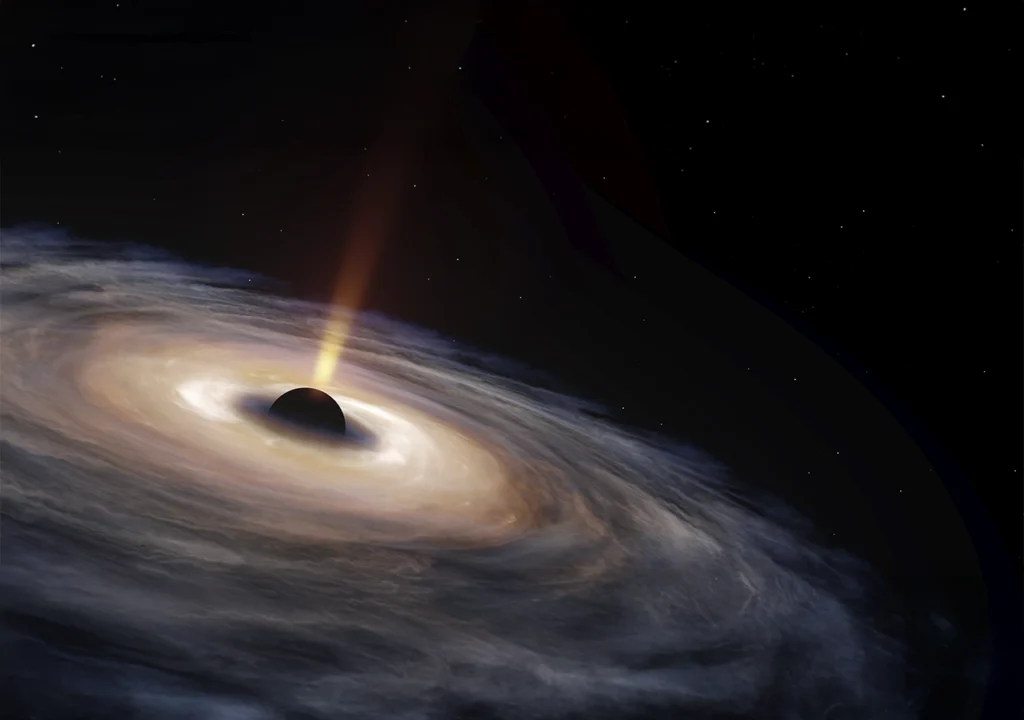
As you get closer, gravity bends light. You would see background stars distorted into arcs, rings, and smeared patterns. This effect is gravitational lensing. If the black hole has an accretion disk—hot gas spiraling in—you’d see a bright, warped ring of light. Parts of the disk might appear above and below the black hole due to extreme bending of light paths.
The Real Danger Often Starts Outside the Horizon
In many real environments, the area around a black hole is not calm. Accretion disks can glow in X-rays and other high-energy radiation. Jets can blast particles at near-light speed. If you approached an active black hole, radiation could be lethal long before you ever reached the event horizon. A ‘quiet’ black hole, with little surrounding gas, is a safer thought experiment—but still fatal eventually.
Tidal Forces and Spaghettification
Why Your Feet and Head Feel Different Gravity
Gravity drops with distance. Near a black hole, the difference between the pull on your feet and the pull on your head can become enormous. This creates tidal forces that stretch you. The smaller the black hole, the steeper the gravity gradient near the horizon, and the stronger the stretching becomes.
Small vs Supermassive Black Holes
For a stellar-mass black hole, tidal forces near the horizon can be strong enough to tear you apart quickly. For a supermassive black hole, the horizon is much larger, and the gravity gradient at the horizon can be gentler. In that case, you might cross the event horizon intact—only to face stronger tidal forces deeper inside.
Crossing the Event Horizon
You Might Not Notice the Moment
If you were falling freely and the black hole were supermassive and relatively quiet, the crossing could feel surprisingly normal locally. No alarm. No sudden shock. The strange part is not what you feel, but what becomes impossible: after crossing, escape is no longer part of your future.
What Distant Observers Would See
From far away, an observer would see you slow down as you approach the horizon. Your light would become increasingly redshifted and faint. In many descriptions, you appear to freeze and fade near the horizon, never quite crossing in their view. But in your own frame of reference, you cross in finite time and continue inward.
Inside the Black Hole: Where Physics Gets Uncertain
The Classical Prediction: A Singularity
General relativity predicts that, inside, you inevitably move toward a central region where density and spacetime curvature become extreme. This is often called a singularity. However, singularities also signal that our equations have reached a regime where new physics is needed. We expect quantum gravity effects to matter, but we do not yet have a complete, experimentally confirmed theory that describes the interior in full detail.
The One-Way Nature of the Interior
Inside the horizon, ‘inward’ is not just a direction in space—it behaves like a direction in time. Just as you can’t stop time from moving forward, you can’t stop your path from progressing deeper inward. This is a mind-bending concept, but it’s a key reason black holes are so different from ordinary objects.
What Would You Experience as You Fall Deeper?
Extreme Stretching Eventually Wins
Even if you survive the horizon crossing, tidal forces grow as you move inward. At some point, the stretching becomes catastrophic. Your body would be pulled apart, then your molecules, then atoms. This is not cinematic exaggeration; it’s the outcome of steep gravity gradients.
Information and Communication Stop Working Outward
After the horizon, signals you send outward cannot escape. You could shine a flashlight, scream, or send radio—none of it reaches the outside. This is why the horizon is a boundary of communication as well as motion.
Could Anything Escape a Black Hole?
Hawking Radiation and the Long Game
Quantum effects near the horizon allow black holes to emit extremely faint radiation, called Hawking radiation. Over incredibly long timescales, a black hole could lose mass and evaporate. This does not offer a practical escape route for anything falling in, but it raises deep questions about what happens to information.
The Information Puzzle
Quantum physics suggests information cannot be destroyed, while classical descriptions make it look like information disappears behind the horizon. This tension is known as the black hole information problem. It’s one of the most important puzzles in theoretical physics because it connects gravity, quantum mechanics, and thermodynamics.
Wormholes and Portals: Science vs Popular Culture
Wormholes Are Hypothetical
Some mathematical solutions to Einstein’s equations describe wormholes, but stable wormholes would likely require exotic conditions that have not been observed in nature in the required forms. Real black holes we observe behave like black holes: they have horizons, accretion, jets, and mergers—not confirmed shortcuts to another universe.
Why People Still Ask
The reason this idea persists is that black holes sit where our understanding is stressed. When science says ‘we don’t fully know the interior,’ imagination rushes in. The honest scientific stance is: black holes are real, extreme, and understood well at the horizon and outside; the deepest interior remains a frontier.
How We Know Black Holes Exist
Watching Stars Orbit an Invisible Mass
In some regions, stars orbit something massive that emits little to no light. Their orbits reveal mass packed into a small volume, consistent with black holes. This method has been especially powerful for the supermassive black hole at the center of the Milky Way.
Seeing the Shadow Indirectly
Projects like the Event Horizon Telescope have captured images of a black hole’s shadow by observing glowing gas around it. The dark region is not the black hole itself, but the silhouette created by gravity bending and capturing light paths. It’s a remarkable confirmation of relativity in extreme conditions.
Gravitational Waves From Mergers
When black holes collide and merge, they create ripples in spacetime called gravitational waves. Detectors can measure the wave pattern, and the signals match black hole merger predictions. This is like ‘listening’ to gravity itself.
Conclusion
If you fell into a black hole, you would face a journey shaped by strange visuals, time behaving differently depending on perspective, and tidal forces that ultimately destroy you. Yet the biggest lesson is not the horror—it’s the science. Black holes are laboratories for testing gravity, probing quantum theory, and exploring the deepest rules of reality. Asking what happens if you fall in is really asking how the universe behaves at its most extreme
References:
https://science.nasa.gov/
https://map.gsfc.nasa.gov/
https://www.esa.int/Science_Exploration/Space_Science
https://www.cfa.harvard.edu/
https://www.space.com/