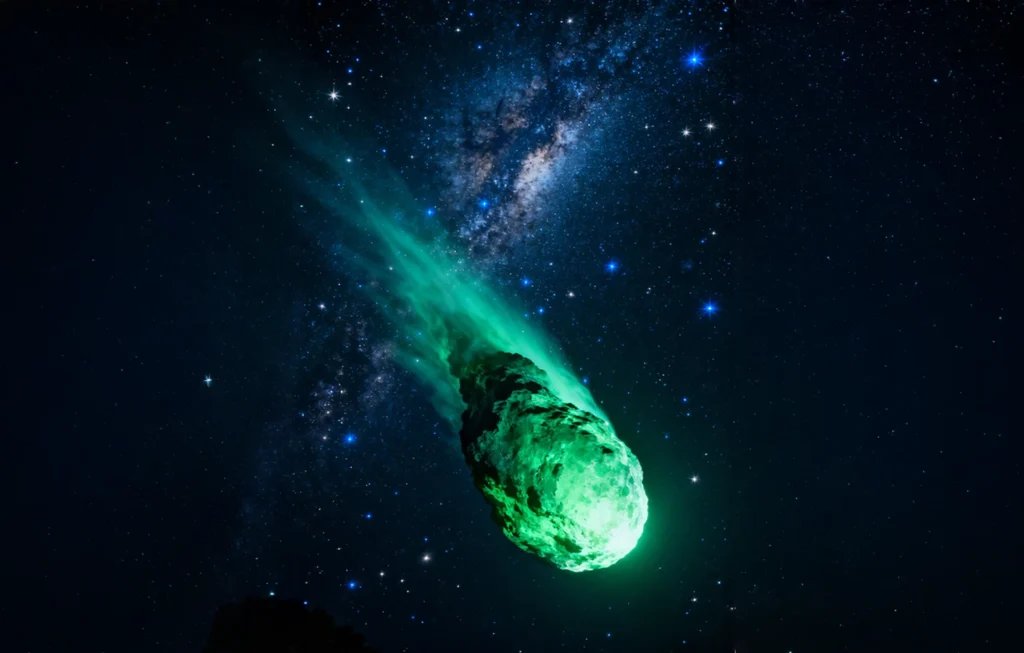
When astronomers talk about cosmic wanderers, few are as fascinating as 3I/ATLAS, the third confirmed interstellar object to pass through our Solar System. Discovered in 2025, it has captured the attention of scientists and space enthusiasts worldwide. From its mysterious origins to its unusual composition, 3I/ATLAS gives us a rare glimpse into the chemistry and physics of another star system.
Discovery and Designation
3I/ATLAS was first detected on July 1, 2025, by the ATLAS (Asteroid Terrestrial-impact Last Alert System) telescope in Rio Hurtado, Chile. The name reflects its discovery and classification — “3I” meaning it’s the third interstellar object (after 1I/ʻOumuamua in 2017 and 2I/Borisov in 2019), and “ATLAS” for the telescope that spotted it.
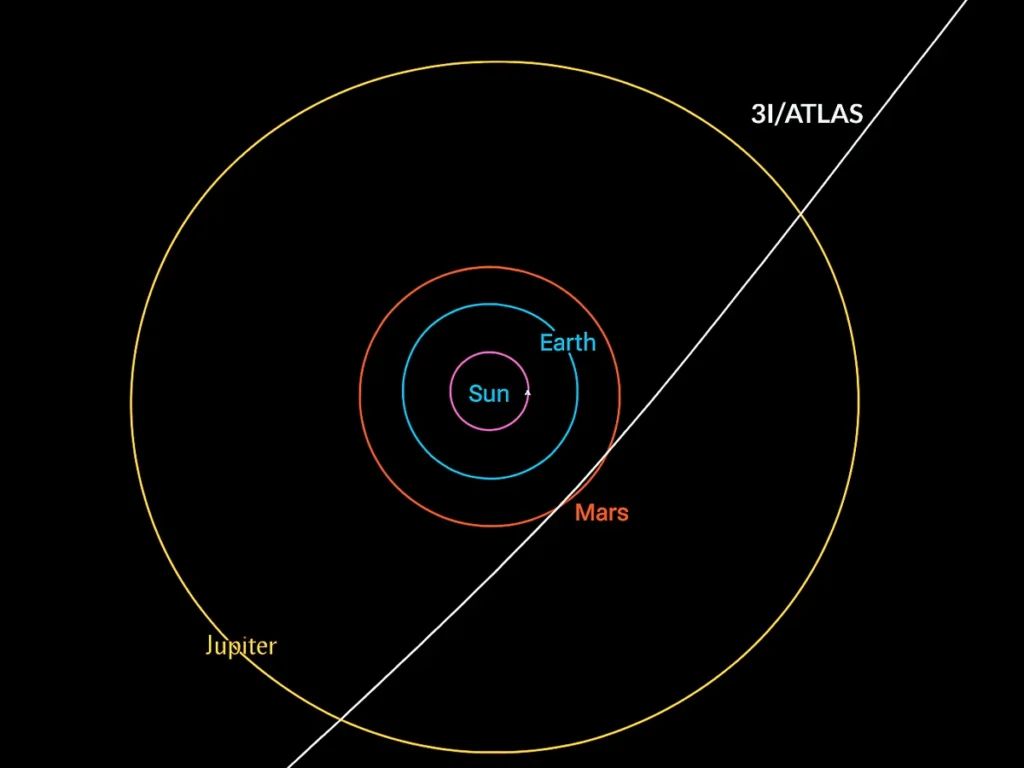
Initial orbital analysis revealed a hyperbolic trajectory, confirming it did not originate in our Solar System. This hyperbolic path means it is only passing through once before heading back into interstellar space. It quickly became one of the most studied astronomical discoveries of the decade, with observatories across the globe focusing on its motion and structure.
Trajectory and Travel Path
3I/ATLAS follows a path that will never loop back around the Sun. Its orbital eccentricity exceeds 1 — the mathematical indicator of a hyperbolic orbit. The comet reached its closest point to the Sun (perihelion) around late October 2025, at approximately 1.36 AU from the Sun, a bit inside Mars’s orbit.
From Earth’s point of view, its closest approach will be around 1.8 AU, meaning it poses no danger. Instead, it offers a fleeting opportunity for observation before it fades back into the blackness between the stars.
Physical Characteristics
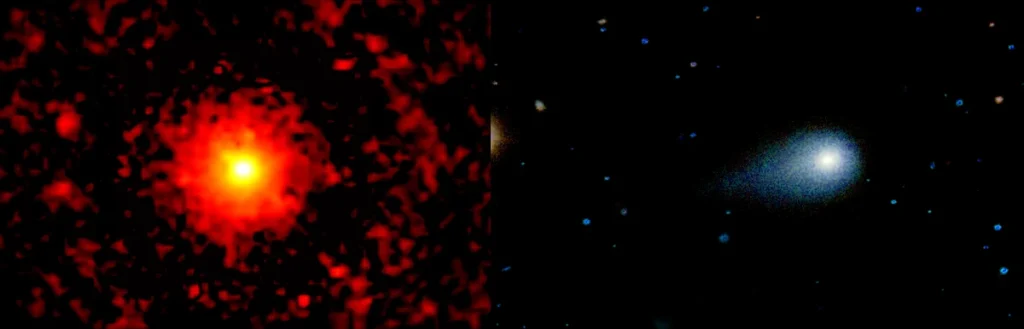
The size of 3I/ATLAS remains uncertain because its core is surrounded by a bright cloud of gas and dust — the coma — making it difficult to measure directly. Current estimates suggest the nucleus might be under one kilometre in diameter. Despite its small size, it reflects sunlight strongly due to the gas and dust released as it warms near the Sun.
Telescopic and spectroscopic observations show that 3I/ATLAS has an unusually high proportion of carbon dioxide (CO₂) compared to water (H₂O). This is one of the highest CO₂/H₂O ratios ever seen in a comet-like object, suggesting it formed in extremely cold conditions, perhaps far from its home star.
Other gases detected include carbon monoxide (CO) and trace compounds like carbonyl sulfide (OCS). These findings hint that this object carries chemical signatures different from anything seen in Solar System comets.
Composition and Unusual Features
What sets 3I/ATLAS apart from local comets is its alien chemistry. Typical comets formed in our Solar System tend to have a dominant water ice composition. 3I/ATLAS, however, appears to be CO₂-dominated, with water as a minor component. This extreme composition indicates it may have formed in a region with much lower temperatures — possibly in the outer reaches of another planetary system or even near the interstellar medium.
Astronomers also noticed that 3I/ATLAS behaves differently from other comets as it approaches the Sun. The rate of gas and dust release seems to fluctuate more dramatically, perhaps due to volatile compounds buried beneath its surface that sublimate in bursts. Its surface could be more porous or loosely bound, causing sudden jets of gas that alter its brightness.
This variation in behaviour gives scientists vital clues about how icy bodies form under different stellar environments and helps refine our models of planetary formation across the galaxy.
Observation and Visibility
For sky watchers, 3I/ATLAS has been an object of great excitement. Early observations showed it as a faint streak in the evening sky from July to September 2025. However, due to its distance and dimness, it required a mid-size telescope or larger to view.
By late October, the comet moved behind the Sun from Earth’s perspective, making observation temporarily impossible. It will reappear in the morning sky around November 2025, but only for a short time before fading away completely.
Even though it’s not visible to the naked eye, astrophotographers and observatories have recorded detailed images showing a greenish coma and a faint tail — classic signs of gas ionisation as sunlight interacts with the comet’s surface materials.
Why 3I/ATLAS Matters
Every interstellar object we detect is a time capsule from another star system. Unlike asteroids or comets that orbit within our Solar System, interstellar visitors like 3I/ATLAS were born around distant stars and later ejected by gravitational interactions. Studying them helps scientists understand what planets and smaller bodies are made of elsewhere in the Milky Way.
3I/ATLAS also strengthens the idea that material is constantly exchanged across the galaxy. It confirms that small bodies can escape their parent systems and travel light-years through space, carrying with them clues about their original environments.
Perhaps most importantly, its detection demonstrates that our observational capabilities have improved dramatically. Just a decade ago, finding such objects was nearly impossible. Now, automated sky-survey systems can spot them long before they pass out of range, allowing telescopes like the James Webb Space Telescope to analyse them in unprecedented detail.
Key Scientific Questions
Even with extensive observation, 3I/ATLAS leaves behind many mysteries:
- How big is the nucleus, really? The coma hides the true surface area.
- What are its exact ratios of ice to dust, and how does that compare to local comets?
- Where exactly did it originate? Was it from the disk of another solar system or an ejected fragment from a binary star system?
- How often do such interstellar visitors pass through our neighbourhood without detection?
- Can future space missions be designed to intercept one of these objects for direct sampling?
Each question pushes the boundaries of planetary science and deep-space exploration.
Future Research and Missions
The discovery of 3I/ATLAS has renewed interest in preparing for rapid-response missions to future interstellar visitors. The idea is simple: once an object like this is detected, a pre-built spacecraft could be launched quickly to intercept it and collect data up close.
Projects such as the Vera C. Rubin Observatory will also make these detections more common by scanning the entire sky repeatedly and catching faint, fast-moving bodies. With every interstellar object discovered, we inch closer to understanding the chemistry and physics of planetary systems beyond our own.
The JWST and other infrared telescopes will continue to monitor 3I/ATLAS as long as possible, analysing its gas emissions and tracking its trajectory. Even after it leaves our Solar System, the data collected will help refine models of how stars eject icy bodies and how those bodies evolve in deep space.
Conclusion
3I/ATLAS is more than just a passing comet — it’s a messenger from another world. Its hyperbolic journey through our Solar System offers a rare opportunity to study truly alien material. Every observation adds a piece to the cosmic puzzle of how planetary systems form and evolve.
Though it will soon vanish back into interstellar darkness, its legacy will endure in the insights it provides. 3I/ATLAS reminds us how vast and interconnected our galaxy is, and that the building blocks of planets and life itself might be shared across countless star systems.
In the years ahead, as telescope technology advances, we will surely detect more interstellar travellers. But for now, 3I/ATLAS stands as a testament to human curiosity and our ability to glimpse the unknown — even when it comes from beyond the stars.
📚 References (Top Ranked Sources)
- NASA Science – “Comet 3I/ATLAS” – science.nasa.gov
- Space.com – “Everything We Know About 3I/ATLAS: The Rare Cosmic Visitor” – space.com
- European Space Agency (ESA) – “Comet 3I/ATLAS – Frequently Asked Questions” – esa.int
- The Debrief – “NASA Official Issues Statement on 3I/ATLAS” – thedebrief.org
- TheSkyLive – “3I/ATLAS Observing Guide 2025” – theskylive.com
- arXiv Astrophysics Preprint – “JWST Detection of a CO₂-Dominated Gas Coma Surrounding 3I/ATLAS” – arxiv.org