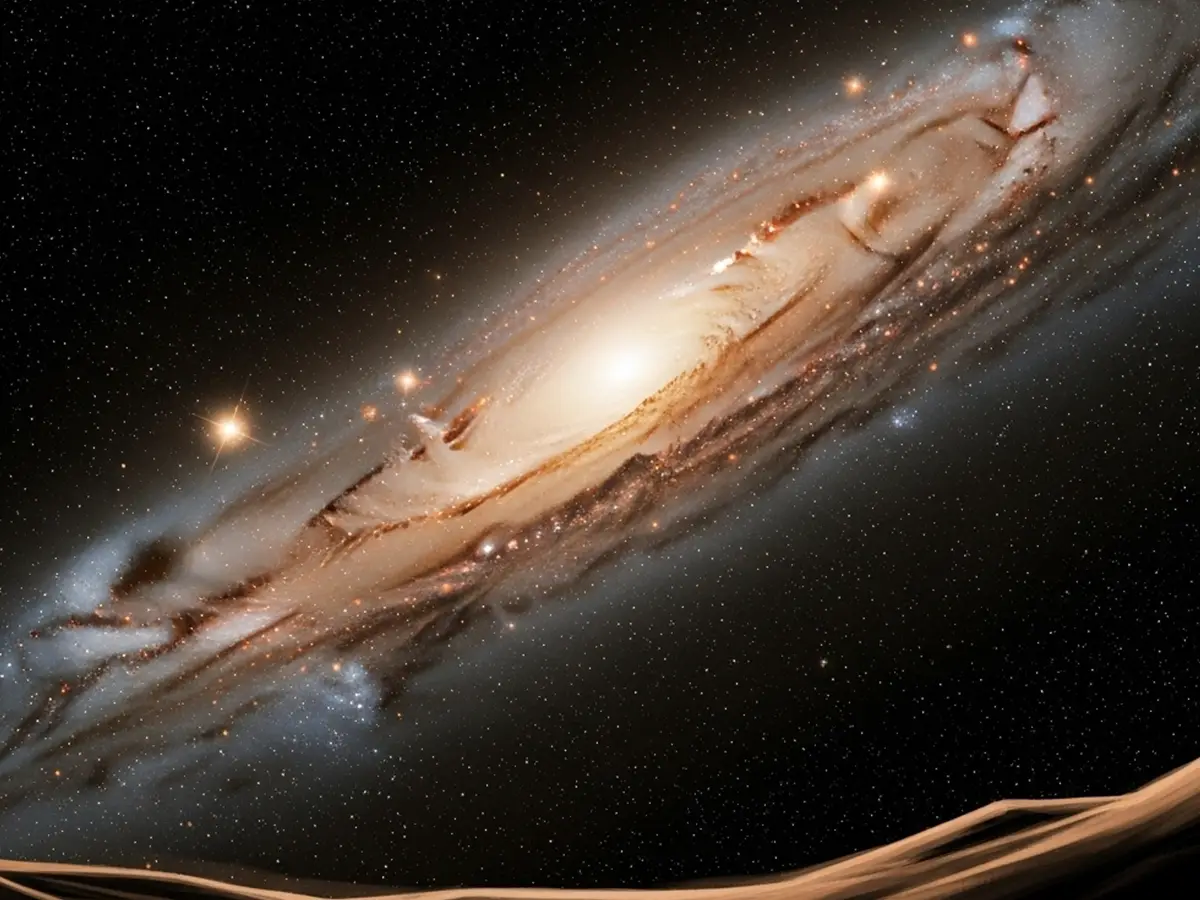
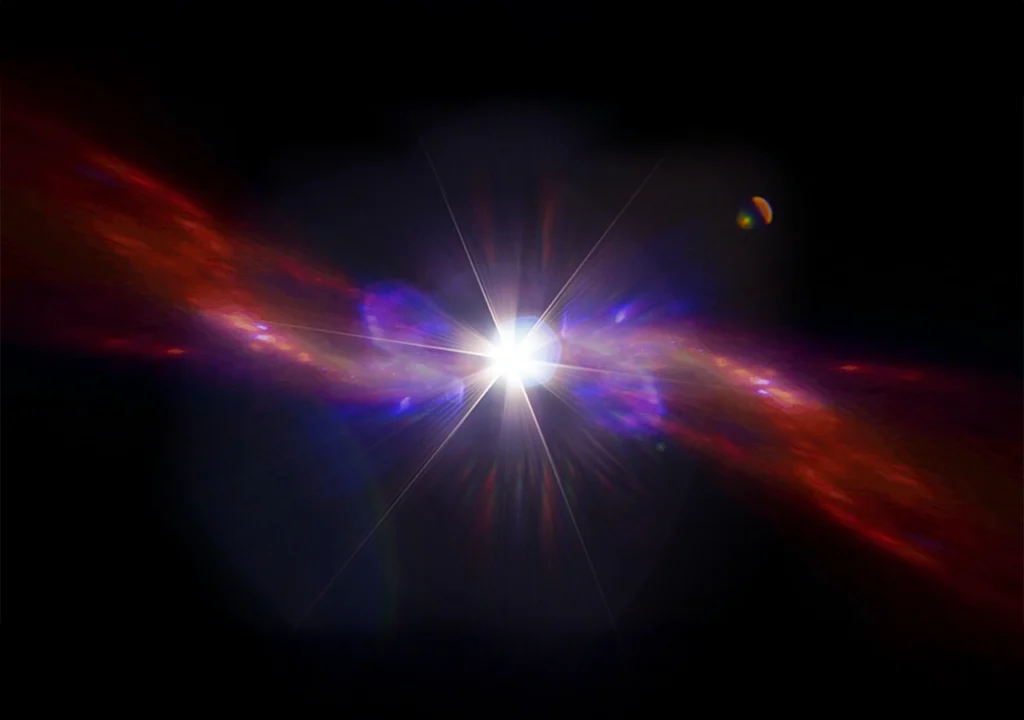
Quasars are among the most powerful and puzzling objects in the universe. At first glance, they appear as tiny points of light, yet they can shine brighter than entire galaxies made up of hundreds of billions of stars. The question of what a quasar is and why it is so bright leads directly into the heart of modern astrophysics, touching on black holes, galaxy evolution, and the extreme limits of physics. Scientists cannot observe quasars up close, so they rely on careful measurements of light, motion, and energy to reconstruct what is happening in these distant cosmic engines.
The Core Idea in Simple Terms
At the center of every quasar lies a supermassive black hole with a mass millions or even billions of times greater than that of the Sun. A black hole itself does not emit light, but the material falling toward it does. Gas and dust pulled in by gravity form a rapidly rotating accretion disk around the black hole. As this material accelerates and collides, it heats up to enormous temperatures and releases tremendous energy. This energy is emitted as radiation across the electromagnetic spectrum, making quasars visible across billions of light-years. The key idea is that quasars are powered by gravity-driven infall: matter loses orbital energy as it spirals inward, and that lost energy reappears as heat and light. This conversion can be surprisingly efficient, meaning a relatively small region around a black hole can outshine the combined starlight of a whole galaxy.
What We Can Measure Directly
Astronomers can measure quasar light across radio, infrared, visible, ultraviolet, X-ray, and gamma-ray wavelengths. Each band reveals different parts of the quasar system. Radio observations can trace jets and lobes stretching far beyond the host galaxy. Infrared can reveal dust heated by the quasar’s radiation. Visible and ultraviolet often come from the hottest portions of the accretion disk. X-rays can arise from extremely energetic regions close to the black hole, including a hot “corona” of particles above the disk. By measuring brightness and spectral shape, scientists estimate how much energy the quasar releases, and how that energy is distributed. The redshift of spectral lines shows how far away the quasar is and how much the universe has expanded during the light’s journey to Earth. Broad and narrow emission lines also give clues about gas speed, density, and chemical composition around the black hole.
What We Must Infer
Even with powerful telescopes, the central engine of a quasar is far too distant and compact to image directly in most cases. Scientists infer the system’s structure by combining multiple signals. If a quasar brightens or dims rapidly, the emitting region must be small because changes cannot propagate faster than light. If certain emission lines are extremely broad, that suggests gas is orbiting very fast, which implies strong gravity and a large central mass. When jets appear, scientists infer that magnetic fields and rotation help launch and collimate those jets, but the exact details can differ among models. Another inference concerns feeding: quasars need a steady supply of matter, which may come from galaxy mergers, gravitational interactions, or internal processes that drive gas toward the galaxy’s center.
How Scientists Investigate This Topic
Telescopes, Spacecraft, and Surveys
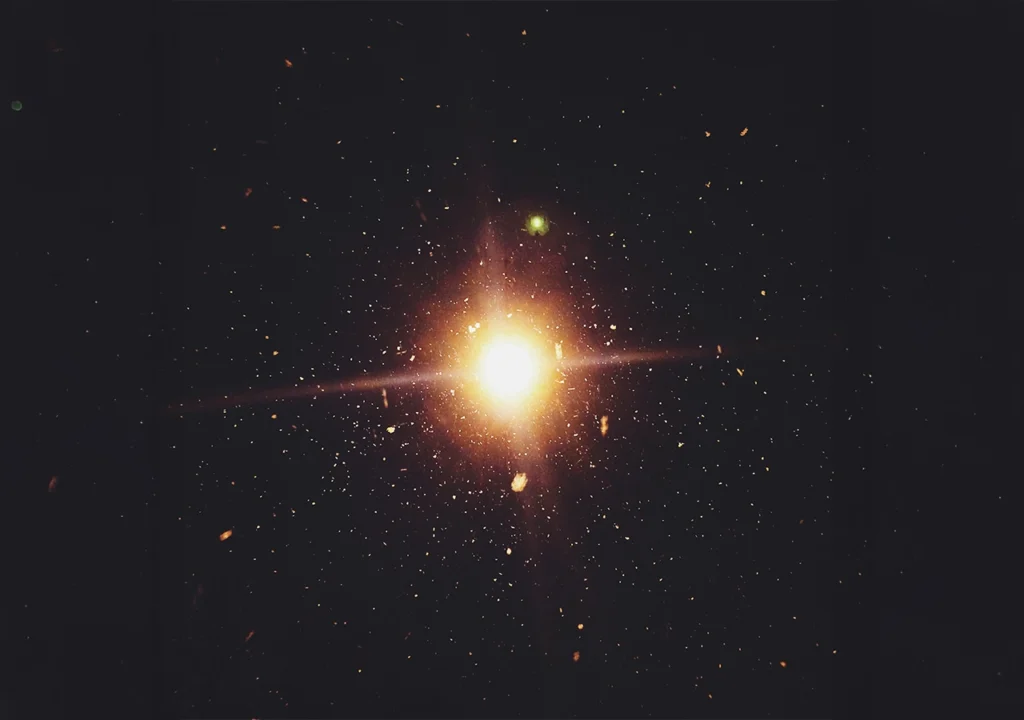
Large sky surveys are essential for finding and classifying quasars because quasars are rare compared to ordinary stars. Surveys scan huge portions of the sky, automatically flagging candidates with unusual colors or spectra. Follow-up observations then confirm whether an object is truly a quasar and measure key properties like redshift and luminosity. Space telescopes can observe ultraviolet and X-ray wavelengths that are blocked or distorted by Earth’s atmosphere. Ground-based observatories, meanwhile, provide flexible long-term monitoring, high-resolution spectroscopy, and wide-field imaging. By building large catalogs, scientists compare quasars across cosmic time, which helps answer questions such as why quasars were more common in the early universe and how their activity relates to galaxy evolution.
Spectra, Timing, and Motion
Spectroscopy is one of the most powerful tools in quasar science. When quasar light is split into wavelengths, absorption features can appear from gas located between Earth and the quasar. Those absorption lines turn quasars into background “flashlights” that reveal the otherwise invisible matter in intergalactic space. Timing studies are equally valuable. Some quasars vary in brightness over days, months, or years. These variations can hint at changing accretion rates, instabilities in the disk, or geometric effects such as portions of the disk being temporarily obscured by dust. Motion measurements can involve mapping how gas responds to the black hole’s gravity. In some cases, techniques such as reverberation mapping measure time delays between changes in the disk’s light and changes in emission lines, which helps estimate the size of the broad-line region and the mass of the black hole.
Simulations and Modeling
Because direct experiments are impossible, simulations provide a virtual laboratory. Models include the physics of accretion disks, magnetized plasma, radiation transport, and relativistic effects near black holes. A strong model must reproduce what we observe, such as the typical quasar spectrum, the distribution of luminosities, and the presence or absence of jets. Simulations also help explore how quasars interact with their host galaxies. For example, intense radiation and winds from a quasar can push gas outward, changing how the galaxy forms stars. When simulations predict patterns that match real galaxy surveys—such as relationships between black hole mass and properties of the galaxy’s central bulge—confidence increases that the models capture something real.
What We Know Today
Reliable Findings
There is strong evidence that quasars are powered by supermassive black holes actively consuming matter. Observations show that most large galaxies host a central supermassive black hole, suggesting quasars are not separate “objects” but a phase in galaxy life when the black hole is rapidly feeding. We also know quasars were more abundant in the early universe. This implies that young galaxies had more available gas, and that black holes grew quickly during that era. Another reliable finding is that quasar light often shows heavy elements, meaning that even early quasars formed after at least some generations of stars had already lived and died, enriching the gas with metals. Quasars also commonly influence their environments through energetic winds and, in some cases, jets that can extend far beyond the host galaxy.
Where the Uncertainty Lives
Major uncertainties remain about how the first supermassive black holes formed and how some grew to enormous masses very early in cosmic history. Scientists debate whether early black holes began as remnants of massive stars, formed through direct collapse of gas, or grew through rapid mergers and accretion. Another uncertainty is why some quasars produce powerful relativistic jets while others do not. Differences in magnetic field strength, black hole spin, or disk structure may matter, but the full picture is still developing. Quasar lifetimes are also uncertain: some may shine intensely for short bursts, while others may remain active longer, turning on and off depending on how much fuel reaches the center.
Common Misconceptions
Viral Myths vs Reality
A common myth is that quasars are “mysterious stars” or strange objects unrelated to galaxies. In reality, quasars are tied to galaxy centers and represent a feeding phase of a supermassive black hole. Another misconception is that quasars are bright because they are physically huge. Brightness does not always mean size. A quasar’s extreme luminosity can come from a relatively compact region because accretion can convert mass to energy efficiently. Some viral explanations also imply quasars are “unknown energy sources.” The basic mechanism—accretion onto a black hole—fits well with physics, even if the fine details remain an active research area.
Mystery Does Not Mean Magic
Quasars operate under the same laws of physics as everything else, just under extreme conditions. Gravity, electromagnetism, and relativity are enough to describe their overall behavior. The mystery is not that science has no rules here, but that the environment is so extreme that multiple processes interact at once: turbulent plasma, intense radiation pressure, strong magnetic fields, and relativistic motion. That makes quasars challenging but still scientific. As instruments improve and datasets grow, uncertainties shrink, and what once felt impossible becomes measurable.
Why This Matters
Big Picture Impact
Quasars help answer some of the biggest questions in cosmology: how galaxies form, how black holes grow, and how matter is distributed across space. Because quasars are so bright, they can be detected at enormous distances, letting astronomers study the young universe. Quasar light also passes through intergalactic gas, allowing scientists to map the “cosmic web” and learn about the evolution of ordinary matter over time. Quasars may also regulate galaxy growth. Their radiation, winds, and jets can heat or remove gas from the host galaxy, slowing or stopping star formation. This feedback may explain why many large galaxies stop forming stars and why black hole mass correlates with galaxy properties.
Human Relevance
Quasar research drives advances in technology and data analysis. Techniques for detecting faint signals, correcting instrument noise, and processing large datasets benefit many fields. Quasars also capture public imagination and motivate scientific literacy, because they show how the universe can produce energy on scales far beyond everyday experience. They also act as natural laboratories for extreme physics, helping scientists test ideas about gravity and high-energy processes that cannot be recreated on Earth.
What to Watch Next
Better Data Is the Key
Future telescopes will observe quasars with higher sensitivity and better resolution, especially at wavelengths that reveal the earliest epochs of black hole growth. Better time coverage will capture variability patterns more precisely, helping distinguish between disk instabilities, obscuration, and fueling changes. Improved spectroscopy will also measure the chemistry and motion of gas around quasars in greater detail, clarifying how quasars feed and how they affect their host galaxies. As new surveys find more quasars, statistical studies will become stronger, revealing whether rare behaviors are truly rare or simply under-sampled.
The Questions That Stay Open
Some questions remain open because they involve physics at extremes—strong gravity, intense magnetism, and relativistic plasma. Other questions remain open because the universe evolves slowly, and we need long observational baselines. Still, each decade of astronomy has turned many “mysteries” into well-understood processes. Quasars will likely follow that pattern: clearer mechanisms, better measurements, and deeper questions. As we push further back in time to the first luminous quasars, we will learn more about how the universe built structure from its earliest stages.
Quasars remain fascinating because they connect real measurements—light, spectra, motion, and timing—to the most extreme environments known. They are not just bright objects; they are signs of galaxies in a powerful phase and black holes actively shaping their surroundings. With each new mission and discovery, our understanding becomes sharper, and the universe becomes even more interesting.
References:
https://science.nasa.gov/
https://www.esa.int/Science_Exploration/Space_Science
https://map.gsfc.nasa.gov/
https://www.space.com/
https://www.cfa.harvard.edu/